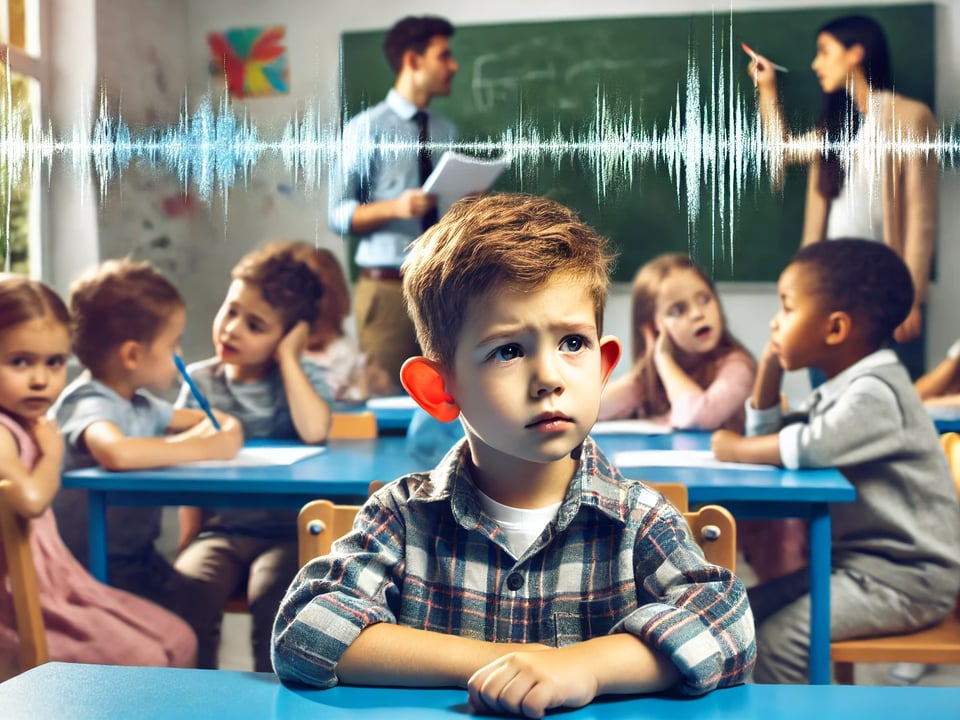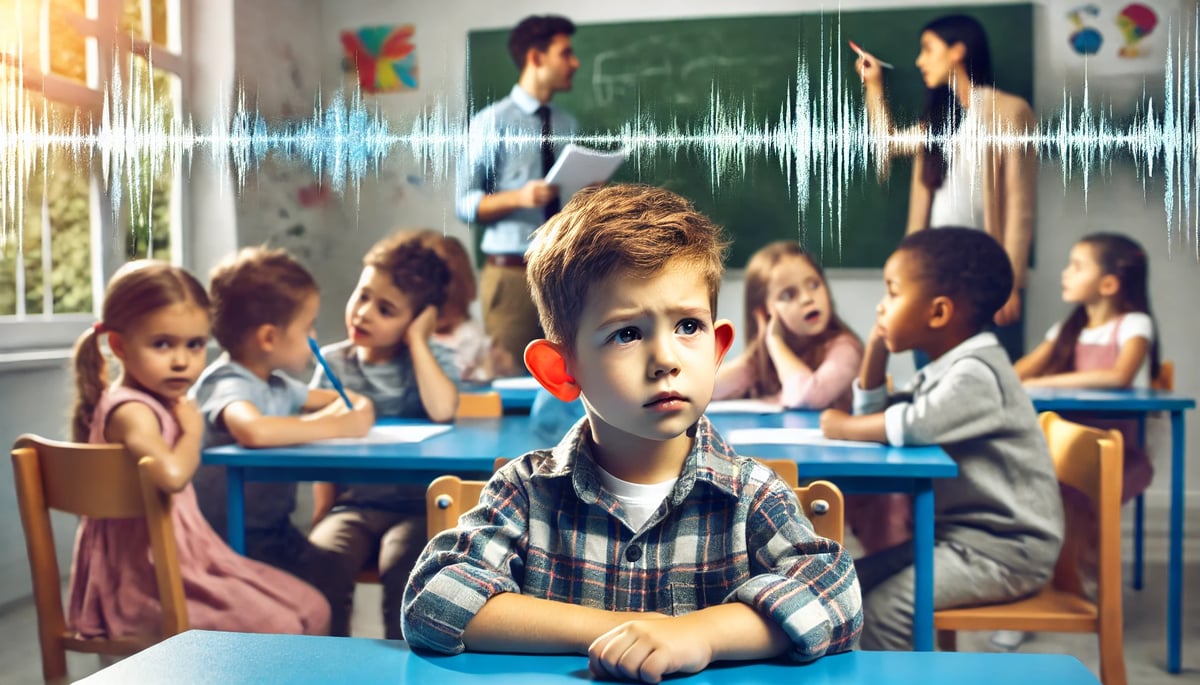

Auditory Processing Disorder (APD), used interchangeably with Central Auditory Processing Disorder (CAPD) and sometimes written “(C)APD,” refers to difficulties in the perceptual processing of auditory information in the central auditory nervous system (CANS) and the neurobiological activity underlying it. The defining clinical feature is a dissociation: the ear and cochlea work normally — the person passes a standard pure-tone audiogram — but the brain struggles to make sense of what it hears, particularly speech in background noise. It is therefore often described as a “hidden” hearing problem.
ASHA’s 2005 Technical Report and Position Statement remain the most-cited definition: (C)APD is a deficit in neural processing of auditory stimuli “not due to higher order language or cognitive factors,” demonstrated by poor performance in one or more of: sound localisation and lateralisation; auditory discrimination; auditory pattern recognition; temporal aspects of audition (temporal integration, discrimination/gap detection, ordering and masking); auditory performance with competing acoustic signals; and auditory performance with degraded signals. ASHA holds that the evidence is sufficient to support (C)APD as a diagnostic entity and that the audiologist is the professional who diagnoses it.
The British Society of Audiology characterises APD as “poor perception of speech and non-speech sounds,” and its guidance explicitly evolved: the 2007 statement tried to define what made APD unique, whereas the 2011 and 2018 statements acknowledge APD commonly occurs in the context of other developmental disorders. In Australia, the NAL 2015 Position Statement (Dillon & Cameron) shifts the emphasis from cause to impact, defining APD functionally as creating “difficulty in listening (i.e. hearing with intent to extract information)” and recommending a hierarchical, ecologically valid approach anchored on speech-in-noise performance and validated questionnaires. APD is coded H93.25 in ICD-10.
The diagnostic debate — presented honestly
This is the most important nuance for a responsible article. There is a genuine, decades-long scientific disagreement about whether APD is a distinct, auditory-specific disorder or a label for a heterogeneous set of listening symptoms driven substantially by attention, language, memory and cognition.
The sceptical position is most associated with Dorothy Bishop (University of Oxford) and David Moore. In their review (Dawes & Bishop, International Journal of Language & Communication Disorders, 2009, 44(4):440–465), they concluded that “APD, as currently diagnosed, is not a coherent category, but that rather than abandoning the construct, we need to develop improved methods for assessment and diagnosis, with a focus on interdisciplinary evaluation,” noting that “a child who is regarded as having a specific learning disability by one group of experts may be given an APD diagnosis by another.” Bishop has separately said the diagnosis “seldom helps in getting the child appropriate intervention.” Moore and colleagues’ influential study of 1,469 randomly chosen 6–11-year-olds with normal hearing across four UK regional centres (Moore, Ferguson, Edmondson-Jones, Ratib & Riley, Pediatrics, Aug 2010, 126(2):e382–e390, MRC Institute of Hearing Research, Nottingham) found that sensory elements of perception were only weakly related to performance measures (r<0.1); “response variability in the AP tests, reflecting attention, and cognitive scores were the best predictors” of listening, communication and speech-in-noise skills — leading to the conclusion that “APD is primarily an attention problem, and treatment should be directed toward control of attention deficit.” A recurring critique is that many APD tests were originally designed for adults with acquired brain lesions and impose linguistic, attentional and memory demands that make it hard to separate a genuine auditory deficit from broader neurodevelopmental immaturity.
The counter-position (ASHA, the American Academy of Audiology, and researchers such as Chermak, Musiek, Iliadou and Bamiou) maintains that (C)APD is a valid modality-specific entity that can be diagnosed if tests are chosen and interpreted to minimise cognitive/language confounds. Cacace and McFarland argued a valid definition must be based on impaired brain function demonstrable for non-speech sounds.
The pragmatic, modernist consensus — and the honest position to take — is a multidimensional, interdisciplinary framework. Listening necessarily integrates “bottom-up” auditory sensory information with “top-down” cognitive information (attention, memory, language). Rather than trying to isolate a single “auditory” cause, current thinking (reflected in the BSA 2018 guidance and recent reviews) increasingly uses the umbrella of “listening difficulties” (LiD) and recommends assessment that examines auditory, language, memory and attention contributions together, with a team of audiologists, speech pathologists, psychologists and educators. The clinical takeaway: APD is a useful description of a real, functionally disabling problem, but it should not be oversold as a single, clean auditory entity.
Symptoms and presentation
Children commonly show: difficulty following spoken (especially multi-step) instructions; trouble understanding speech in background noise or reverberant classrooms; frequent requests for repetition (“what?”, “huh?”); appearing not to listen or being easily distracted; delayed or inconsistent responses; difficulty localising sound; and difficulties with phonics, reading and spelling. NAL’s statement notes these children expend more listening effort, which reduces capacity for other tasks and can be misread as inattention or lack of interest. These signs are shared with ADHD, DLD, dyslexia and autism, so they are suggestive, not diagnostic.
Adults report difficulty understanding conversation in meetings, restaurants and other noisy or group settings; mishearing similar-sounding words; difficulty on the phone (where visual cues are stripped away); and pronounced listening fatigue — the mental exhaustion of consciously reassembling degraded speech, which can drive social withdrawal misread as aloofness.
Comorbidity and overlap are the rule rather than the exception. Otitis media / “glue ear” in early childhood is a recognised risk factor: fluctuating conductive hearing loss during critical developmental windows can affect maturation of the central auditory pathways. In older adults, ageing of the central auditory system (“central presbycusis”) frequently coexists with peripheral age-related hearing loss and cognitive change.
Causes and risk factors
Aetiology is heterogeneous and often unknown (idiopathic). Recognised contributors include: developmental/maturational delay of the auditory pathways; a history of chronic otitis media with effusion; neurological causes (head injury, stroke, tumours, multiple sclerosis, and ageing/neurodegeneration); prematurity and perinatal complications (NICU stay, hypoxia-ischaemia, hyperbilirubinaemia); and genetic/familial factors. A study of children with listening difficulties found significantly elevated risk associated with prematurity (18%, odds ratio ~3.4), head injury (21%, OR ~3.4) and extended high-frequency hearing loss (32%, OR ~2.4).
Assessment and diagnosis
Who diagnoses. Audiologists are the recognised professionals for diagnosing APD, but best practice embeds this in a multidisciplinary team — speech pathologists (language), psychologists (cognition/attention), and educators.
Minimum age. Formal APD testing is conventionally performed from around 7 years, because the auditory system and the age-based test norms require sufficient maturity, and the tasks demand sustained attention and language/cognitive maturity. This convention is debated: some Australian clinics assess from 5–6 years with appropriate test selection, and a large Polish study (1,012 children) argued testing is valid in 6-year-olds. Adults are typically assessed to around 65.
First, rule out the periphery. A full diagnostic audiological assessment (pure-tone audiometry, tympanometry/immittance, acoustic reflexes and otoacoustic emissions) is mandatory first, because even a mild peripheral loss can mimic APD. A recent comprehensive audiological evaluation (typically within 6 months) is required before an APD evaluation.
Behavioural test battery. Uses verbal and non-verbal stimuli across categories:
- Dichotic listening (binaural integration/separation): e.g. Dichotic Digits Test, Competing Words/Sentences.
- Temporal processing: gap detection (Random Gap Detection Test, Gaps-in-Noise), and frequency (pitch) and duration pattern tests.
- Monaural low-redundancy speech: filtered/time-compressed speech tests.
- Binaural interaction: e.g. Masking Level Difference, binaural fusion.
- Speech-in-noise / spatial listening: including the Australian-developed Listening in Spatialized Noise – Sentences test (LiSN-S), which measures “spatial advantage” and is used to diagnose spatial processing disorder (SPD).
Electrophysiological / objective measures help corroborate findings and locate the level of dysfunction: auditory brainstem response (ABR), auditory middle-latency response (AMLR), and cortical/long-latency auditory evoked potentials (including P300, mismatch negativity, and frequency-following responses), plus otoacoustic emissions to confirm cochlear integrity. A systematic review found these can help characterise children with suspected APD but concluded their value for screening needs further study; cortical potentials are notably affected by attention and language experience.
Disentangling confounds. Because attention, language and memory shape test performance, the work-up should include (or refer for) language, non-verbal IQ, phonological processing and attention screening, and integrate all results into a management plan — consistent with the BSA 2018 and Australian multidisciplinary approach.
Treatment and management
Management follows three evidence-based categories, best combined (“bottom-up” plus “top-down”). Realistically, it is about strategies, support and technology — not cure.
(a) Environmental modifications / improving the listening environment. Reduce background noise; preferential seating near the speaker and away from noise sources; acoustic treatment of classrooms (soft furnishings, reduced reverberation); and speaker/teacher strategies — gaining the child’s attention before speaking, using clear speech, pausing, and rephrasing rather than simply repeating. These are low-risk, widely endorsed and among the more strongly supported strategies.
(b) Assistive listening technology.Personal remote-microphone systems (previously called FM systems; e.g. Phonak Roger, with the Roger Focus receiver designed for normal-hearing/APD children) transmit the speaker’s voice directly to the listener, dramatically improving the signal-to-noise ratio. This is among the best-supported interventions: Johnston et al. (2009) showed improved speech perception, academic and psychosocial benefits; and a randomised controlled trial by Stavrinos, Iliadou, Pavlou & Bamiou (Frontiers in Neuroscience, 21 Aug 2020, 14:904; UCL Ear Institute) — which randomised 26 children aged 7–12 with APD into intervention (n=13) and control (n=13) groups — found that 6 months of remote-microphone hearing aid use improved classroom listening with no adverse effects on spatial listening or attention skills. There is evidence of both assistive benefit and, with prolonged use, therapeutic neuroplastic change. Sound-field amplification distributes the teacher’s voice evenly across a classroom and benefits all students.
(c) Auditory training and compensatory strategies.
- Deficit-specific auditory training has the best evidence when it precisely targets a measured deficit. The Australian LiSN & Learn program (now the iPad app Sound Storm, Cameron & Dillon), which trains spatialised listening, improved spatial processing in children with SPD in a randomised blinded controlled study — and importantly, a non-spatial program (Earobics) did not, underscoring the need for deficit-specific training.
- Broad commercial auditory-training software (e.g. Fast ForWord, Earobics) marketed generally for APD has weak or mixed evidence. The systematic review by Fey, Richard, Geffner, Kamhi et al. (Language, Speech, and Hearing Services in Schools, Jul 2011, 42(3):246–264), which analysed 25 studies from 28 databases, concluded: “The evidence base is too small and weak to provide clear guidance to speech-language pathologists faced with treating children with diagnosed APD, but some cautious skepticism is warranted until the record of evidence is more complete,” and found little indication that improvements are due to the auditory features of these programs. This is a key honesty point for patients: claims of broad “brain training” cures are not well supported.
- Compensatory / central-resource strategies (“top-down”): metacognitive strategies, active-listening training, language and vocabulary support, memory and attention strategies, and self-advocacy. Speech pathology plays a central role in language and communication support.
Adults, including older adults. Management mirrors children’s — environmental control, remote-microphone technology, and communication strategies — plus formal auditory training. LACE (Listening and Communication Enhancement) is a computer-based adult auditory-training program with some evidence of improving speech-in-noise and competing-sentence understanding, particularly in new hearing-aid users; however, the systematic review of computer-based auditory training in adults (Henshaw & Ferguson, 2013) found generalisation to untrained tasks was small and not robust, and some trials (e.g. Saunders et al., 2016) found no benefit. In older adults, where central presbycusis and cognitive change contribute, managing any co-occurring peripheral hearing loss (e.g. well-fitted hearing aids) is important, and untreated hearing loss is itself a leading modifiable risk factor for dementia.
Manage comorbidities. Treating co-occurring peripheral hearing loss, and addressing comorbid ADHD, language disorder or dyslexia through the appropriate professionals, is essential — often more impactful than APD-specific therapy alone.
Outcomes / prognosis
There is no “cure.” Realistic outcomes are meaningful improvements in day-to-day listening, communication, confidence and (for children) classroom access, achieved through a combination of environmental change, technology, targeted training and support. Children’s outcomes benefit from neuroplasticity — the developing auditory system can reorganise, and earlier, deficit-specific intervention during peak plastic periods is generally advantageous. Adults retain capacity for functional reorganisation but typically rely more on technology and compensatory strategies. Expectations should be framed around functional goals, not test scores.
Australian context
Guidance. Audiology Australia’s Professional Practice Guide (2022) addresses both APD assessment (Sub-domain 4.11) and APD management (Sub-domain 5.10), and includes a dedicated multidisciplinary-approach sub-domain (5.4), framing diagnosis within audiology scope and management within a team model. The NAL 2015 Position Statement (Dillon & Cameron) is the key Australian research-body document, defining APD functionally and recommending hierarchical speech-in-noise-anchored testing (LiSN-S) with validated questionnaires. Australia has been a world leader in APD test and treatment development: the NAL/Australian Hearing national CAPD service (Cameron, Glyde, Dillon, King & Gillies, Seminars in Hearing, 2015, 36(4):216–236) gathered data from 38 Australian Hearing centres over 18 months, assessing 666 individuals aged 6y0m–24y8m (median 9y0m); of these, 408 were diagnosed with a defined profile — spatial processing disorder (n=130), verbal memory deficit (n=174) or binaural integration deficit (n=104).
Prevalence context. APD in children is often cited at around 3–5% of the school-age population. In older Australians, the Blue Mountains Hearing Study (Golding et al.) reported a strikingly high 76.4% prevalence of central auditory processing abnormality on one or more of seven speech-based tests in a population aged 55+, with severity increasing with age — a figure that reflects that study’s population and test criteria and should not be generalised to the wider population.
Funding. APD assessment in Australia is largely private/out-of-pocket. There is no dedicated Medicare item for a full APD assessment, but partial rebates are accessible via a GP Chronic Disease Management (Team Care Arrangement) plan covering up to 5 allied-health sessions per year (currently roughly $60 rebate per session). Assessments are commonly delivered over multiple (3–4) sessions and priced in the several-hundred-dollar range. The Australian Government’s Hearing Services Program (Hearing Australia) covers permanent/long-term hearing loss, not APD with a normal audiogram. Private health “extras” cover may provide partial audiology rebates, depending on the fund.
NDIS. APD is not an automatically eligible/listed NDIS condition; eligibility is based on permanent and significant functional impairment evidenced by audiologist reports, not on the diagnostic label. In practice, APD-related supports (speech pathology, capacity building, assistive technology including remote-microphone systems) are more reliably funded when a participant has an eligible primary disability (e.g. autism, intellectual disability, hearing loss). Some provider/marketing websites overstate APD as an automatically “NDIS-recognised” condition — the accurate framing is functional-impairment-based eligibility.
Remote-microphone funding. For children with permanent hearing loss, Hearing Australia provides remote-microphone systems at no cost — but this generally excludes APD-only children with normal hearing. For APD, remote-microphone systems are funded via NDIS (where eligible), sometimes through schools/education departments as reasonable adjustments, or by private purchase. Complete Roger transmitter-plus-receiver kits are typically in the ~$1,000–$2,500 range depending on the transmitter model. (Note: unlike New Zealand, which has a formal Ministry of Education remote-microphone funding scheme for diagnosed APD students, Australia has no single uniform national school scheme; provision varies by state, school, NDIS and private purchase.)
Referral pathways. Typical entry points are the GP, paediatrician, school (teachers/learning-support), and ENT. A GP or paediatrician referral both enables a Medicare rebate pathway and ensures peripheral/medical causes (e.g. otitis media) are addressed first; ENT involvement is important where there is a history of ear disease. Audiologist-led primary-contact models are increasingly used in Australian paediatric ear/hearing services.
Recommendations
For patients/parents (staged):
- Start with a full diagnostic hearing test to rule out peripheral hearing loss and middle-ear problems — this must come first. If a child has a history of recurrent ear infections/glue ear, involve a GP or ENT.
- Wait until ~7 years for formal APD testing unless a clinician recommends earlier assessment with age-appropriate tools; before then, focus on ear health, language support and classroom accommodations.
- Pursue a multidisciplinary assessment, not audiology alone — ask about screening for attention, language and memory, because these commonly co-drive the symptoms.
- Prioritise the best-supported interventions first: listening-environment changes and a trial of a personal remote-microphone system, alongside speaker/communication strategies.
- Be a critical consumer of “auditory training”: favour deficit-specific programs matched to a measured deficit (e.g. Sound Storm/LiSN & Learn for spatial processing disorder); treat broad “brain-training” cure claims with caution.
- Sort out funding early: ask your GP about a Chronic Disease Management plan for Medicare rebates; check private health extras; and if there is a significant, permanent functional impairment or an eligible primary disability, explore NDIS.
Thresholds that change the plan: If attention or language emerges as the dominant driver, prioritise ADHD/DLD management (which may yield greater functional gains than APD-specific therapy). If a peripheral or middle-ear problem is found, treat that first and re-test. If a remote-microphone trial produces clear classroom benefit, that supports continued use and funding applications.
Caveats
- APD is genuinely contested. Leading researchers dispute whether it is a distinct auditory-specific diagnosis; symptoms overlap heavily with ADHD, DLD, dyslexia and autism. This article deliberately avoids presenting APD as a single clean entity.
- No universally accepted “gold-standard” test exists; different diagnostic criteria and test batteries can change who is labelled with APD.
- Evidence quality varies sharply by intervention: environmental strategies and remote-microphone systems are reasonably supported (some from small or uncontrolled studies); broad commercial auditory-training software is weakly/mixed-supported; adult auditory-training evidence (including LACE) shows limited generalisation.
- Australian funding figures and NDIS eligibility are policy-dependent and change over time; confirm current details with Services Australia/Medicare, the NDIS, Audiology Australia and your clinic before relying on them. Exact private assessment fees are rarely published and vary by clinic and session structure.
- Some statistics (e.g. the ~76% prevalence of central auditory abnormality in older Australians in the Blue Mountains Hearing Study) come from specific study populations and criteria and should not be over-generalised.