
Most families searching for a children’s audiologist in Sydney are past the “just checking” stage. They’ve been sent by a speech pathologist who’s concerned about language delay. Or their child failed a school screening. Or they’ve been told “the hearing test was fine” but their gut says otherwise because their eight-year-old still can’t follow instructions in noise. What parents need is someone who understands that paediatric audiology is a different discipline entirely—one that requires age-specific protocols, developmental knowledge, and, frankly, the patience to spend 40 minutes obtaining reliable thresholds from a toddler who’d rather be anywhere else.
Why Paediatric Audiology Requires Specialist Training
Children are not small adults, and their auditory systems are not simply quieter versions of ours. The assessment techniques we use change every few months in infancy, and every few years through childhood. For a newborn, we’re using automated ABR (auditory brainstem response) or otoacoustic emissions testing—objective measures that don’t require behavioural response. By six months, we’re transitioning to visual reinforcement audiometry, where the child learns to turn toward sound when they hear it, rewarded by an animated toy. At two and a half to three years, we move to play audiometry—drop the block in the bucket when you hear the beep. From about four or five onward, we can usually obtain conventional pure tone audiometry, the hand-up-when-you-hear-it method adults know.
But even within those protocols, there’s enormous variation in how a child presents. A four-year-old with autism spectrum disorder may not engage with play audiometry at all, requiring creative modification or a return to VRA. A child with auditory processing disorder may have perfect pure tone thresholds but struggle profoundly with speech-in-noise testing or dichotic listening tasks. A seven-year-old with glue ear may test normally one month and show a 30 dB conductive loss the next—you need to know the trajectory of the condition, not just the snapshot.
The Audiology Australia scope of practice for paediatric audiology explicitly acknowledges this complexity. It’s not a subspecialty in name only. Assessment protocols must be developmentally appropriate, soundfield testing must be calibrated differently than insert earphones, and interpretation requires understanding normal versus delayed auditory development. Dr Carly Steers, principal audiologist at The Audiology Place, completed her Doctor of Audiology (AuD) with extensive paediatric clinical placements and has spent more than twenty years refining these skills. She currently teaches at the University of Sydney and directs the paediatric program at A.T. Still University, which means she’s training the next generation of paediatric audiologists—not just seeing patients, but shaping clinical standards.
What a Paediatric Assessment at Our Clinic Actually Involves
We start with case history, but not the tick-box version. I want to know about pregnancy and birth history, speech and language milestones, family history of hearing loss, whether your child had frequent ear infections, whether they startle to loud sounds, whether they ignore you or genuinely don’t hear you. These details guide the entire session.
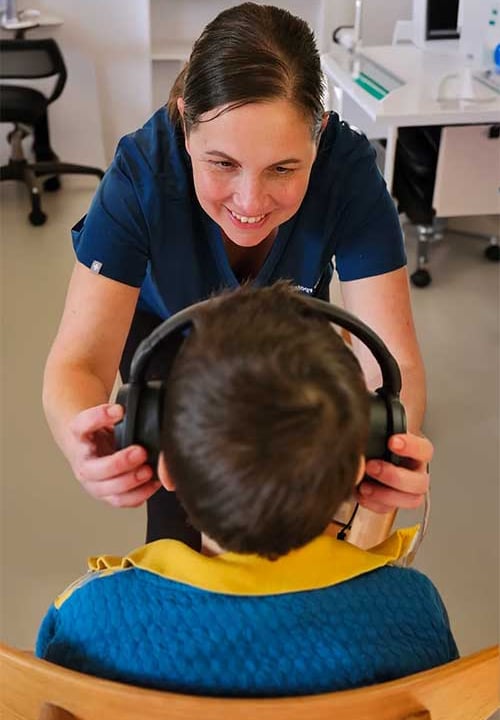
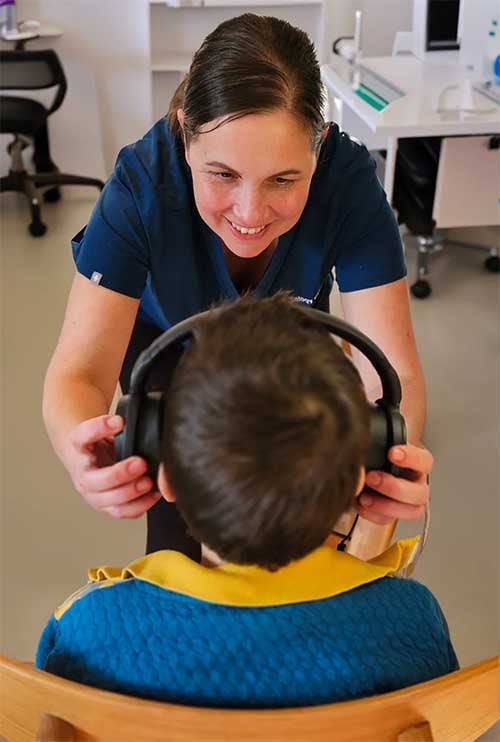
For infants and toddlers, we’ll conduct tympanometry first—a quick, objective test that tells us whether the middle ear is functioning properly or whether there’s fluid behind the eardrum (the hallmark of glue ear, or otitis media with effusion). Then we move to age-appropriate threshold testing. With babies, that’s usually otoacoustic emissions (OAEs) and occasionally diagnostic ABR if we’re concerned. With toddlers, it’s visual reinforcement audiometry in soundfield, meaning we present sounds through speakers and watch for a conditioned head turn. By preschool age, we’re using play audiometry with insert earphones or headphones to get ear-specific thresholds.
For school-aged children, particularly those referred for auditory processing concerns, we conduct a full diagnostic audiometry battery first—because you cannot diagnose APD unless peripheral hearing is confirmed normal. That means pure tone air and bone conduction thresholds, tympanometry, acoustic reflex testing, and speech audiometry. If those are clear, and the child is at least seven years old, we can proceed to APD assessment. We offer both APD Part 1 (screening) and Part 2 (comprehensive diagnostic assessment), which includes dichotic digits, pitch pattern sequences, filtered speech, and speech-in-noise testing using the LiSN-S (Listening in Spatialized Noise–Sentences), a test normed on Australian children.
When to Seek a Paediatric Audiologist in Sydney
There’s a tendency in healthcare to wait and see, and sometimes that’s appropriate. But with hearing, delay means missed language development windows. You should seek assessment if your child:
– Failed newborn hearing screening or a school hearing test
– Isn’t meeting speech and language milestones (no babbling by 9 months, fewer than 10 words by 18 months, unintelligible speech by age 3)
– Has frequent ear infections or fluid in the ears that isn’t resolving
– Asks “what?” constantly, even in quiet
– Struggles to follow multi-step instructions
– Has difficulty hearing in background noise (can’t follow conversation at the dinner table, struggles in the classroom)
– Turns the TV up louder than other family members
– Has a history of NICU admission, particularly if they required ventilation or ototoxic medications (gentamicin, for instance)
– Has a syndrome or condition associated with hearing loss (Down syndrome, cleft palate, cranial abnormalities)
– Has a family history of childhood hearing loss
We also see many children referred by speech pathologists. If your child is in speech therapy and progress has plateaued, hearing assessment—including APD testing where age-appropriate—should be part of the diagnostic picture. We collaborate regularly with speech-language pathologists, occupational therapists, and paediatricians, because auditory function doesn’t exist in isolation.
The Limitations of Quick Hearing Checks
Many parents arrive having already had their child’s hearing “tested” somewhere—a GP clinic, a pharmacy booth, a mobile school screening. These are valuable as screening tools but they are not diagnostic assessments. A screening test is designed to be quick and to catch obvious hearing loss. It may be conducted in a less-than-ideal acoustic environment, using limited frequencies, without tympanometry, and often without age-appropriate conditioning.
I’ve assessed countless children whose parents were told “hearing is fine” after a screening, only to find a mild high-frequency loss, or fluctuating conductive loss from glue ear, or perfectly normal audiogram thresholds but profound difficulty with auditory processing. Screenings also don’t assess middle ear function, so a child can “pass” while sitting with chronic effusion that’s affecting sound clarity and language development.
A diagnostic paediatric assessment takes 45 to 60 minutes, sometimes longer. It’s conducted in a sound-treated booth. It’s tailored to your child’s developmental age, attention span, and cooperation level. And it gives you a complete picture: air conduction, bone conduction, middle ear status, speech understanding, and where relevant, auditory processing capability.
Red Flags That Shouldn’t Wait
Some situations require urgent assessment. If your child has sudden hearing loss—noticed overnight or after an illness—don’t wait for an appointment next month. Sudden sensorineural hearing loss in children is rare but requires prompt medical and audiological intervention, ideally within 72 hours. Similarly, if your child has a head injury and you notice hearing changes, or if there’s ear discharge with hearing loss, these need same-day medical review, not a routine audiology booking.
If your newborn didn’t pass their initial hearing screening and you’ve been told to “wait and retest in a few months,” don’t accept that without question. Refer to a paediatric audiologist for diagnostic assessment. Early intervention in hearing loss—ideally before six months of age—dramatically improves language outcomes. Waiting is not benign.
What Happens After the Assessment
If hearing is normal and there are no concerns, you’ll leave with reassurance and guidance about monitoring. If we identify hearing loss, the next steps depend on the type and degree. Conductive loss from glue ear may warrant a watching brief if mild, or ENT referral if persistent or affecting speech. Sensorineural hearing loss will require hearing aid fitting, and for infants and young children, enrolment in early intervention services such as Australian Hearing’s paediatric program (which provides government-funded devices for children).
If APD is diagnosed, management is never just “here’s a list of classroom accommodations.” We provide specific recommendations based on subtest results—auditory training exercises, FM systems where appropriate, collaboration with your child’s school and therapists, and re-assessment to monitor progress.
We also provide copies of reports to any relevant professionals—your GP, paediatrician, ENT, speech pathologist—with your consent. Paediatric hearing assessment should never be a siloed event.
Why We’re Independent, and Why It Matters
The Audiology Place is not owned by a hearing aid manufacturer, a retail chain, or a franchise. We’re not incentivised to fit devices when they’re not needed, and we’re not limited to a single brand when they are. For children, this independence is particularly important. Paediatric hearing aid fitting is complex—devices need to be durable, tamper-resistant, compatible with FM systems, and programmed using paediatric prescriptive formulas like DSL v5. We choose technology based on the child’s loss, age, and lifestyle, not based on what we’re contracted to sell.
It also means we can take the time assessment requires. We’re not running on a fifteen-minute retail model. If your child needs a break halfway through, we take one. If testing requires two sessions to get reliable results, we book two sessions.
A Note on Costs and Rebates
Paediatric diagnostic audiology is usually partially covered by Medicare (item 11309 for comprehensive diagnostic assessment, with additional items for tympanometry and other tests where clinically indicated). Private health funds with audiology extras cover diagnostic assessments depending on your level of cover. Australian Hearing provides free assessments and devices for children under 26 who meet criteria, which includes most permanent childhood hearing loss. We’re not an Australian Hearing site, but we refer families when appropriate and collaborate on complex cases.
For APD assessments, there is typically an out-of-pocket cost, as Medicare rebates don’t cover the full complexity of the test battery. We provide detailed quotes before proceeding.
Final Thoughts from the Clinic
I’ve seen what early identification and proper paediatric audiology care can do. I’ve watched nonverbal toddlers begin to babble after hearing aid fitting. I’ve seen children labelled as inattentive or oppositional thrive once their APD was diagnosed and managed. I’ve also seen the cost of delay—the eight-year-old with moderate hearing loss who was missed as a baby and is now years behind in literacy, the teenager with undiagnosed APD who thinks they’re “just dumb.”
If you’re searching for a paediatric audiologist in Sydney because something doesn’t feel right with your child’s hearing, trust that instinct. You’re not overreacting. You’re doing exactly what a parent should do: seeking answers from someone who knows how to find them.
**Disclaimer:** This article is for information purposes and does not replace individualised clinical assessment. If you have concerns about your child’s hearing, book a diagnostic appointment with a qualified paediatric audiologist.