
The hearing aids that perform best in meetings share one technology: directional microphones sophisticated enough to separate a single voice from background noise, air conditioning hum, and the shuffle of papers across a boardroom table. Three current premium options take distinct approaches to that problem: Phonak’s Sphere models, Oticon Intent and Signia’s IX platform. But the biggest difference in real-world meeting performance often comes from an accessory that doesn’t get mentioned early enough: a remote microphone.
You’ve noticed you’re working harder than your colleagues to follow conversations in conference rooms. You’re watching lips, filling in gaps, nodding when you’re not entirely sure what was agreed. You’ve probably already tried repositioning yourself at the table, arrived early to grab the seat with the best sightlines, and turned up the volume on video calls until your family complains. You’re wondering whether hearing aids will actually solve this, or whether you’ll spend several thousand dollars only to find yourself in the same position with bits of plastic in your ears.
The answer depends on two things: the speech-in-noise capability of the device itself, and whether you’re willing to use a remote microphone when the room exceeds what even the best hearing aid can manage on its own.
Why Conference Rooms Are Acoustically Brutal
Most modern offices are designed to look clean, which means hard surfaces: glass partitions, polished concrete, floor-to-ceiling windows. Sound bounces. By the time speech reaches your ears, it’s competing with reflected sound from every direction, air-conditioning hum, and the rustle of at least one person who can’t sit still. Background noise in a meeting room doesn’t need to be loud to be enough to mask the subtle acoustic cues your brain needs to separate one voice from another, especially if you already have high-frequency hearing loss above 2000 Hz.
The clinical term is “speech-in-noise deficit,” and it shows up on testing long before a patient notices problems in quiet, one-on-one conversation. We measure it using the QuickSIN or similar adaptive sentence tests delivered through headphones with competing babble noise. If your signal-to-noise ratio (SNR) loss is moderate or worse, meaning you need speech to be well above the background noise to follow it as well as someone with normal hearing, you’re likely to struggle in busy meetings however hard you concentrate.
The Three Platforms That Actually Handle It
It’s worth talking about specific products, because vague reassurances don’t help you decide. These three are current premium options, each with a different approach to speech in noise.
Phonak’s Sphere models use a dedicated AI chip to run a deep neural network trained to separate speech from noise. In practice, this means the hearing aid can reduce more background noise without the underwater, muffled quality that older noise reduction could produce. Sphere sits at the top of Phonak’s range.
Oticon Intent takes a different approach: alongside its noise processing, it uses what Oticon calls “4D Sensor technology”, which takes into account your head and body movement, conversation activity and the sound environment to decide how much to focus on the speech you’re engaged with. If you turn toward a colleague on your left during a meeting, the hearing aids adapt. This suits active participants who engage with different speakers. It’s less relevant if you’re sitting still through a presentation.
Signia Integrated Xperience (IX) builds on Signia’s split-processing approach, separating the speech you’re focused on from the surrounding sound and processing each separately before recombining them, with features aimed at conversations involving several people. It’s particularly suited to situations where people around you are talking to you, including small groups.
All three are Bluetooth-enabled for phone calls, which matters more than most patients realise. You can take a call directly through your hearing aids, which routes audio to both ears and eliminates the distortion that happens when you hold a phone against a microphone. Whether your own voice is picked up by the hearing aid microphones during calls (hands-free calling) depends on the model and the phone, so check this with your audiologist if you take a lot of calls.
The Accessory That Changes Everything: Roger and Remote Microphones
Here’s what I wish every manufacturer made clearer in their brochures: even the best hearing aid, processing sound from microphones sitting in or behind your ear, is limited by physics. Sound decays with distance. Reverberation increases. Beyond about two metres in a noisy room, you’re asking a microphone the size of a match head to perform a miracle.
Remote microphones are among the most underused tools in workplace hearing care. Roger is Phonak’s remote microphone system. The Roger On is a small microphone you place in the centre of a boardroom table or clip to a presenter’s lapel. It picks up speech close to the source, where the signal-to-noise ratio is still favourable, and transmits it to your hearing aids over Phonak’s dedicated Roger wireless system.
The difference is not subtle. A microphone close to the talker improves the signal-to-noise ratio far more than hearing aid microphones can on their own, and that’s often the gap between guessing and actually participating.
Roger works with many modern hearing aids, not just Phonak, though other brands usually need a small receiver attached, so check compatibility first. Recent Phonak hearing aids can receive Roger directly. It’s not cheap, but if your job depends on communication, it’s often money well spent.
Oticon and Signia make their own remote microphone accessories, such as Oticon ConnectClip and Signia StreamLine Mic, which work in a similar way. They work well for one-to-one conversations and small meetings. For large rooms with several talkers, Roger’s ability to link several microphones together gives it an edge.
What About Telecoil and Hearing Loops?
If your workplace has a hearing loop (found in some lecture theatres, courtrooms and meeting rooms), your hearing aids’ telecoil can pick up sound directly from the loop with far less background noise. It works very well when available, but realistically, most Australian workplaces haven’t invested in loop systems. I mention it because if you’re specifying aids and you do work in a looped environment (or attend conferences in loop-equipped venues), make sure your audiologist activates the telecoil program. Not all manufacturers include it by default, especially in the smallest receiver-in-canal models.
Discretion, Stigma, and the Practical Reality of Wearing Aids at Work
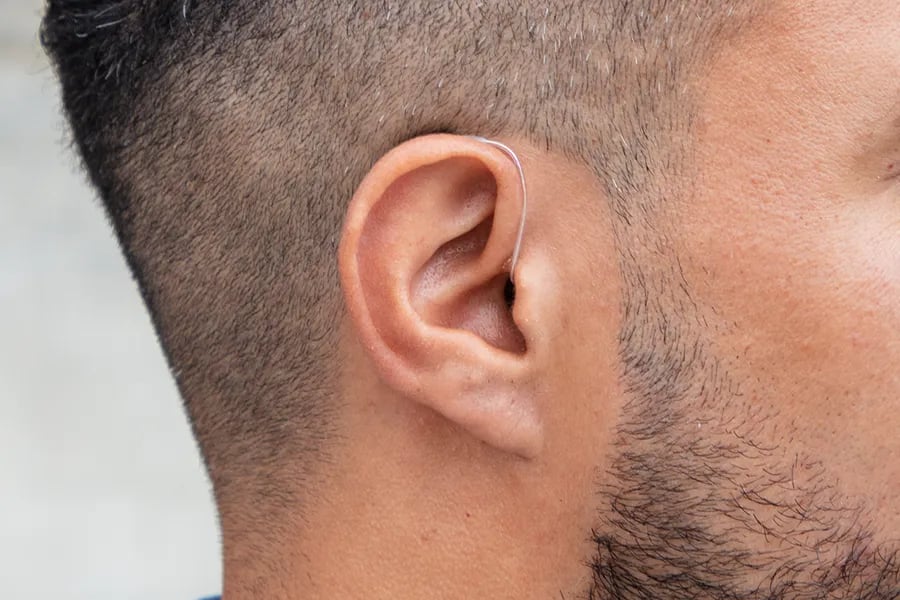
I’m not going to pretend stigma isn’t real. Plenty of working-age patients worry that clients will assume they’re “past it”. Modern receiver-in-canal styles, with a slim case behind the ear and a thin wire to a small speaker in the ear canal, are barely visible unless someone is looking for them.
The reality is that the people who do notice are usually relieved, because they’ve been repeating themselves and didn’t want to make you uncomfortable by pointing it out. But if discretion matters to you, all three platforms I’ve discussed are available in small, modern cosmetics. The days of beige bananas are over.
Realistic Expectations and What Happens in the Clinic
If you have moderate high-frequency loss (typical of noise exposure, ageing or both) and good word recognition scores on diagnostic testing, you should expect substantial improvement in meetings, especially with directional microphones and optional remote mic. If you have severe loss or poor word recognition on diagnostic testing, the benefit will be more limited. Hearing aids amplify and clarify sound, but they can’t restore clarity that’s been lost due to cochlear or neural damage.
At our clinics, a full diagnostic assessment for a working-age adult includes pure-tone audiometry, speech-in-noise testing, tympanometry to rule out middle-ear issues, and sometimes otoacoustic emissions if we’re concerned about early cochlear dysfunction. We’ll also ask detailed questions about your specific listening environments (open plan or closed offices, how many video calls, whether you travel for work), because the ideal device and settings for a software developer on Zoom all day is different from a site manager moving between office and factory floor.
Real-ear measurement (REM) is non-negotiable for professional users. This involves placing a probe microphone in your ear canal while you’re wearing the aids, then measuring the actual sound level near your eardrum to verify it matches prescriptive targets. Without REM, you’re guessing, and many poorly performing hearing aids are simply mis-fitted, not incapable.
We schedule follow-up appointments over the first few months, with remote fine-tuning available between appointments if you’re struggling with a specific situation: your office moved you into a noisier workspace, or you’ve started a new role with more presentations.
Australian Pricing, Private Health, and Workplace Support
None of this is cheap. Premium hearing aids plus a remote microphone are a significant investment, and prices vary with technology level and what’s included. Private health extras cover may contribute, but rebates depend on your fund and level of cover.
If you hold a DVA Gold Card, or a White Card for a hearing-related condition, or you’re otherwise eligible for the government Hearing Services Program, subsidised hearing aids may be available. Most working-age professionals won’t qualify, but it’s worth checking.
Some employers will contribute to hearing aids or a remote microphone as a workplace adjustment, particularly if your role is client-facing or involves safety-critical communication. For day-to-day tips, see our guide to hearing aids at work. It’s worth having the conversation with HR, especially if you can frame it as a retention issue: it’s cheaper for them to fund aids than to lose a skilled employee who’s disengaging because they can’t function in meetings.
When to Act and What to Do Next
If you’re still reading, you’ve probably already recognised yourself in this description: working harder than everyone else to follow what’s being said, declining invitations to after-work drinks because you can’t manage pub noise, feeling exhausted by mid-afternoon from the cognitive load of filling in gaps. That’s not going to improve on its own. Hearing loss of this kind doesn’t recover on its own, and long periods without amplification can make it harder to adjust to hearing aids later.
Book a full diagnostic appointment with an audiologist, ideally at an independent clinic rather than a hearing aid retailer. Ours take 90 minutes. Make sure the clinic does real-ear measurement, ask about trial periods, and be specific about your workplace challenges so they can program and accessorise accordingly.
If you’re in Sydney and want a straight conversation about whether aids will actually help your situation, we’re at The Audiology Place in Epping and Forestville, and you’re welcome to ask questions that aren’t in a brochure. This is information, not a hard sell: we’d rather you make an informed decision than spend money on devices you won’t wear.