

Lenire is a treatment device for chronic tinnitus. Australia’s Therapeutic Goods Administration approved it in September 2025, and The Audiology Place is one of a limited number of accredited clinics fitting it in Australia. It is not a cure, and it does not suit everyone. A large part of what we do before recommending it is work out whether it is likely to help you.
If you have lived with ringing, buzzing or hissing that will not settle, you have probably been told there is nothing to be done. That is not quite true. Lenire is one of the better researched options to appear in years, and it is now available in Sydney through our Forestville and Epping clinics.
How Lenire works
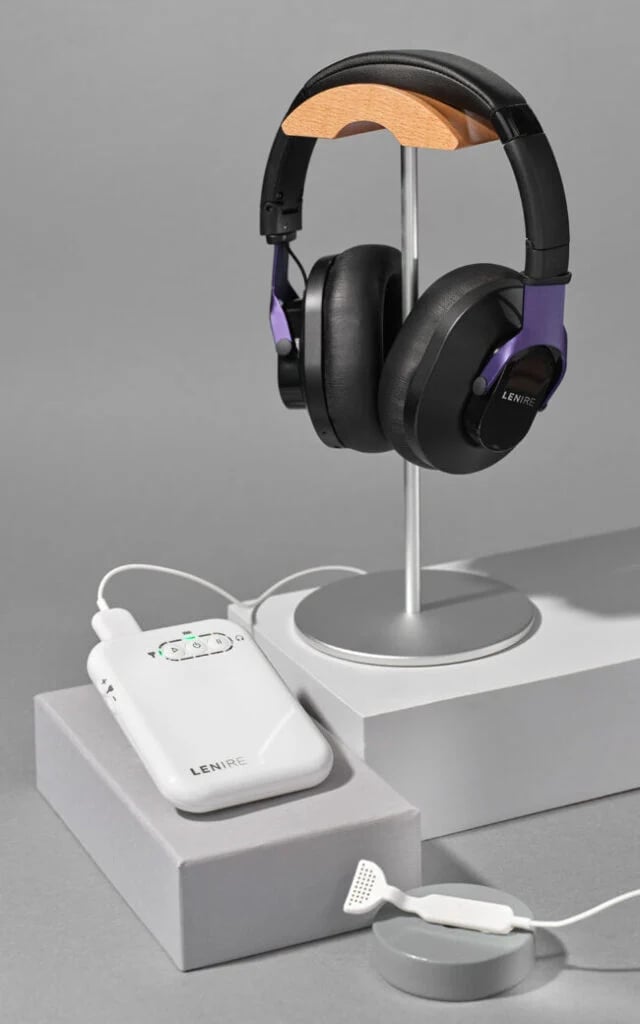
Lenire treats tinnitus through bimodal neuromodulation, which means two things happen at once. You listen to a set of tones and soundscapes through wireless headphones while a small device called a Tonguetip delivers mild electrical pulses to the surface of your tongue. Pairing sound with tongue stimulation is designed to change the way your brain processes the tinnitus signal, so that over time you pay less attention to it. A handheld controller lets you adjust the volume and the strength of the tongue pulses during each session. The settings are matched and prescribed to your hearing and tinnitus profile by your Audiologist rather than fixed out of the box, which is why the device has to be fitted by a trained provider instead of bought off a shelf.

What the evidence shows
Lenire has been through more clinical testing than most tinnitus treatments. Its two largest published trials, TENT-A1 and TENT-A2, involved more than 500 participants who used the device for twelve weeks. In TENT-A2, around 95 per cent of participants who used it as directed reported an improvement in their tinnitus, and 91 per cent of those still reported benefit a year after treatment finished. A separate real-world review of 220 patients, published in Nature Communications Medicine, found that 91.5 per cent had a clinically meaningful reduction in tinnitus after twelve weeks. Those figures come with two qualifications that matter. They describe people who completed the treatment as directed, using the device consistently across the full course. And the phrase “clinically meaningful” has a defined meaning in this research: an improvement of at least seven points on the Tinnitus Handicap Inventory, one of the questionnaire Audiologists use to measure how much tinnitus interferes with daily life. The results are real, but they are not a guarantee that everyone improves. We would rather tell you that upfront than sell you a number.
Who Lenire suits
Lenire is approved for adults aged 18 and over with chronic subjective tinnitus, the kind that only you can hear. It tends to help most where the tinnitus is persistent and bothersome enough to affect sleep, concentration or mood. It is not the right starting point for everyone. If your tinnitus is recent, one-sided, or pulses in time with your heartbeat, we would want to find the cause before reaching for a device, because those patterns can point to something that needs investigating in its own right. Tinnitus also often sits alongside hearing loss, and for some people, treating the hearing loss changes the tinnitus on its own. Sorting out what is actually driving your symptoms is part of the assessment, and it comes before any decision about Lenire.
What we tell you before you start
We are an independent clinic. We are not owned by a hearing aid or device manufacturer, and no one here earns a commission on what we recommend. That independence matters most with a treatment like this one. Lenire is a genuine option backed by genuine research, and it is also a cost and a commitment of two daily sessions across at least 12 weeks. So we will give you a straight answer on whether we think it is likely to help you, what the evidence does and does not show, and what the alternatives are. If we do not think it is the right fit for your tinnitus, we will say so and point you somewhere more useful.
What the process looks like at The Audiology Place
It starts with a full tinnitus and hearing assessment, which is a proper diagnostic appointment rather than a quick screening. We take a detailed history, test your hearing across the standard and extended frequency range, and measure the character of your tinnitus, and utilise questionnaires to give us baseline perceptions of not just the tinnitus, but also other potential co-morbid concerns such as insomnia, mental health and sound sensitives. If Lenire is appropriate, we fit and customise the device to your profile and take you through how to use it.
From there you use Lenire at home, two 30-minute sessions a day, for a minimum of around 12 weeks. You come back for check-ins during the course so we can review your progress and adjust the settings. Tinnitus shifts slowly, so those check-ins do real work. They let us fine-tune the treatment rather than leave you to interpret it alone. At the end of the course we review where you have landed and talk through whether continued use makes sense for you. Some people keep going because they find the sessions calming. Others taper off once they have the result they were after.
Why come to us for Lenire
Tinnitus is one of the areas we work in most. The Audiology Place is led by Dr Signe Steers, who has more than twenty years in audiology, lectures at the University of Sydney and A.T. Still University, and sits on the board of Independent Audiologists Australia. Alongside her, Charlen Lavoie and Dr. Nick Morrison bring more than two decades of clinical experience across Australia and Canada.
We see tinnitus, hyperacusis and misophonia regularly, and Lenire now sits alongside the other approaches we use, from sound therapy and management strategies to treating underlying hearing loss where that is part of the picture. Fitting Lenire well takes clinical time and judgement. That is the kind of work the practice is built around.
Book a tinnitus assessment
If tinnitus is affecting your daily life and you want to know whether Lenire could help, book a tinnitus assessment at our Forestville or Epping clinic. We will assess your hearing and your tinnitus first, then give you an honest read on whether the device is worth pursuing.
Phone: (02) 9315 8327
Email: admin@theaudiologyplace.com.au
Forestville: Unit 12/14 Starkey Street, Forestville NSW 2087
Epping: Shop 3, 22 Cambridge Street, Epping NSW 2121
Web: theaudiologyplace.com.au
Common questions about Lenire
Is Lenire approved in Australia?
Yes. The Therapeutic Goods Administration approved Lenire on 11 September 2025 and lists it on the Australian Register of Therapeutic Goods as a Class IIa medical device for adults with chronic subjective tinnitus. It has also held FDA approval in the United States since 2023.
Is Lenire a cure for tinnitus?
No. There is no cure for tinnitus at present. Lenire is designed to reduce how much your tinnitus intrudes on daily life, so that it fades into the background rather than dominating your attention. Many people find that valuable, but it is a treatment, not a cure.
Does the tongue stimulation hurt?
No. The Tonguetip delivers mild pulses that most people describe as a light tingle or fizz, kind of like having sparkling water in your mouth. You control the intensity yourself with the handheld controller and set it to a level that feels comfortable.
How long does treatment take?
The standard course is two 30-minute sessions a day for a minimum of around 12 weeks, used at home. You attend check-ins with us during that period so we can track progress and adjust the settings.
Will it work for me?
That depends on the type and cause of your tinnitus, which is exactly what the initial assessment is for. Lenire helps many people with chronic subjective tinnitus, though not everyone responds, and some forms of tinnitus need a different approach. We will give you a realistic view of your chances before you commit.
Always read the instructions for use. Follow the instructions for use. If symptoms persist, talk to your health professional.