

For musicians, singers, and performing artists, hearing loss doesn’t just affect everyday communication—it fundamentally threatens the ability to perceive pitch, timbre, and the subtle harmonic overtones that define musical expression. Whether you’re a professional orchestral player, a weekend jazz enthusiast, or a vocalist navigating complex harmonies, selecting the right hearing aid requires far more consideration than simply amplifying sound. The relationship between music and hearing technology is nuanced, and getting it right demands an understanding of how musical signals differ fundamentally from speech.
Why Standard Hearing Aids Fall Short for Musicians
Most hearing aids are engineered primarily for speech perception. Speech typically occupies a frequency range between 250 Hz and 6,000 Hz, with most critical information concentrated between 500 Hz and 4,000 Hz. The temporal patterns of speech are relatively predictable, and the dynamic range—the difference between the softest and loudest sounds—rarely exceeds 30 decibels in typical conversation.
Music, by contrast, is an entirely different acoustic beast. A full orchestra can produce sound pressure levels exceeding 110 dB, whilst a pianissimo passage might hover around 40 dB—a dynamic range of 70 dB or more. The frequency spectrum extends from the 27.5 Hz fundamental of a piano’s lowest A to well beyond 10,000 Hz for the brilliance and “air” of cymbals, string harmonics, and vocal sibilants. Perhaps most critically, musicians rely on the perception of complex harmonic relationships—the overtone series that allows us to distinguish a violin from an oboe playing the same note.
When a conventional hearing aid encounters music, several problems emerge. Aggressive compression algorithms designed to make soft speech audible whilst keeping loud speech comfortable can flatten musical dynamics into an unrecognisable mush. Limited bandwidth that rolls off sharply above 6,000 Hz strips away the acoustic information that conveys brightness and presence. Distortion occurs when loud passages exceed the device’s input limits, creating the sort of clipping artefacts that make any audiophile wince.
Dr. Marshall Chasin, a leading researcher in musicians’ hearing health, has extensively documented how standard hearing aid processing can render music unlistenable for trained ears. His work, alongside that of researchers like Dr. Jens Jørgen Schmidt, has helped drive the development of dedicated music programs and processing strategies that respect the unique demands of musical signals.
Essential Features for Musician-Focused Hearing Aids
When working with musicians at The Audiology Place, several key features prove non-negotiable for maintaining musical fidelity whilst providing necessary amplification.
Extended bandwidth stands paramount. The best hearing aids for musicians offer frequency responses extending to at least 10,000 Hz, and ideally higher. This extended high-frequency response preserves the harmonic richness and “colour” of instruments. Widex has been particularly progressive in this domain, with some models offering bandwidth extending beyond 12,000 Hz—a specification that matters enormously when you’re trying to hear the difference between a well-struck triangle and a cymbal wash.
Dedicated music programs with modified compression ratios represent another critical feature. These programs typically employ lower compression ratios (often 2:1 or less compared to 3:1 or higher for speech programs), slower attack and release times to preserve natural amplitude envelopes, and sometimes completely linear amplification for mild losses. The ability to disable noise reduction algorithms is equally important, as these systems can interpret musical passages—particularly those with rapid rhythmic elements or dense harmonies—as “noise” requiring suppression.
High input level tolerance prevents the distortion that occurs when forte passages overwhelm the hearing aid’s input stage. Modern devices designed with musicians in mind can handle input levels of 100-110 dB SPL without clipping, compared to 85-90 dB for many standard devices.
Adjustable compression characteristics allow fine-tuning for different musical contexts. A singer in a quiet rehearsal room has vastly different needs than a drummer in a rock venue. The flexibility to adjust these parameters—ideally through programmable settings accessible via smartphone apps—provides the adaptability that musical life demands.
Brand and Model Recommendations
Whilst audiological care should always be brand-agnostic and driven by individual needs, certain manufacturers have demonstrated sustained commitment to serving the musician population through research, development, and clinical outcomes.
Widex has established a particularly strong reputation amongst musicians and the audiologists who serve them. Their Moment and SmartRIC platforms offer the extended bandwidth previously mentioned, alongside a dedicated Music program with expanded dynamic range. The company’s TruAcoustics technology and PureSound processing have been specifically designed to minimise the delay between acoustic sound entering the ear canal and processed sound from the hearing aid—a delay that can create a disturbing echo effect when musicians hear themselves play. For performers who rely on direct acoustic input and amplification, this near-zero delay is invaluable.
Phonak, Switzerland’s hearing technology giant, offers compelling options through its Audéo Lumity and Paradise ranges. Their AutoSense OS includes a dedicated music program that adapts to different musical environments, and the ActiveVent receiver technology allows switching between an open fitting (for maximum acoustic sound preservation) and a closed fitting (for more amplification when needed). For musicians with mild to moderate loss who still receive substantial acoustic information, this flexibility can be transformative.
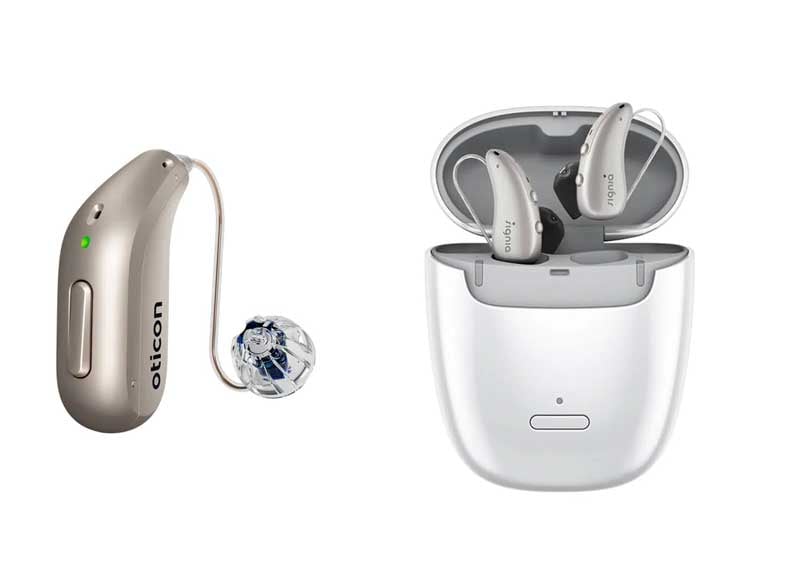
Signia deserves particular mention for vocalists and singers, thanks to their Own Voice Processing (OVP) technology. This feature separately processes the wearer’s own voice, reducing the occluded, booming quality that often plagues singers wearing hearing aids. When you’re trying to monitor pitch accuracy and vocal quality whilst performing, hearing your own voice naturally becomes absolutely essential. The Signia Pure and Styletto platforms, incorporating OVP, have proven successful with the vocal performers I’ve worked with at our clinic.
For classical musicians and those in acoustic ensemble settings, custom in-the-ear devices warrant consideration. Whilst receiver-in-canal (RIC) devices dominate the market and work well for many musicians, custom shells can provide superior retention during performance, reduced wind noise for outdoor performances, and can incorporate specific venting strategies tailored to the musician’s specific instrument and hearing loss configuration.
In-Ear Monitors: A Special Consideration
Many contemporary musicians, particularly in popular music genres, use in-ear monitors (IEMs) for stage monitoring rather than traditional wedge speakers. The interaction between hearing aids and IEMs requires careful management. Some musicians successfully use their hearing aids with IEMs when the aids are programmed with minimal processing—essentially functioning as sophisticated, individualised frequency-shaping devices. Others find that custom-moulded IEMs with frequency response tailored to compensate for their hearing loss (without hearing aids) provide a cleaner signal path.
This decision requires individual assessment, preferably with the opportunity to trial different configurations in realistic musical settings. At The Audiology Place, we work with musicians to arrange trial periods that encompass their actual performance and rehearsal environments, as the acoustics of a clinical suite rarely replicate the conditions of a concert hall or recording studio.
Prevention: The Most Important Hearing Aid is the One You Don’t Need
Before concluding, the professional responsibility of any audiologist writing for musicians demands emphasis on hearing conservation. Custom musician earplugs, designed to provide relatively flat attenuation across frequencies (typically 9, 15, or 25 dB reduction), preserve sound quality whilst reducing exposure to damaging levels. These are not the foam plugs from the pharmacy—they’re precision devices that allow musicians to continue hearing accurately whilst protecting against noise-induced hearing loss.
For musicians already experiencing hearing loss, the combination of appropriately fit hearing aids for amplification alongside continued use of hearing protection during high-level exposures creates the best strategy for preserving remaining hearing function.
Making the Right Choice for Your Musical Life
Selecting hearing aids as a musician requires partnership with an audiologist who understands both the technical demands of music perception and the practical realities of musical performance. This means moving beyond standard speech-in-noise testing to include music perception assessment, discussing specific instruments and performance contexts, and establishing realistic expectations about what current technology can and cannot achieve.
Key questions to discuss with your audiologist include:
– What is the frequency bandwidth of the recommended devices, and how does this align with your instrument’s range?
– Can music programs be customised for different musical contexts (practice, performance, listening)?
– What are the options for direct audio streaming from instruments, mixing desks, or practice apps?
– How will the devices interact with any existing in-ear monitors or hearing protection you use?
– What trial period is available, and can it encompass actual performance situations?
Next Steps
If you’re a musician experiencing hearing difficulties, or if you’ve been dissatisfied with previous hearing aid experiences, a comprehensive audiological assessment focused on your specific musical needs represents the essential first step. This should include standard diagnostic audiometry, speech perception testing, Real Ear Measurement for verification, and frank discussion of your musical activities, goals, and concerns.
At The Audiology Place, our work with performing artists, from professional orchestral musicians to community choir members, has demonstrated repeatedly that with appropriate technology selection, careful programming, and individualised follow-up, musicians can continue their artistic lives whilst managing hearing loss effectively.