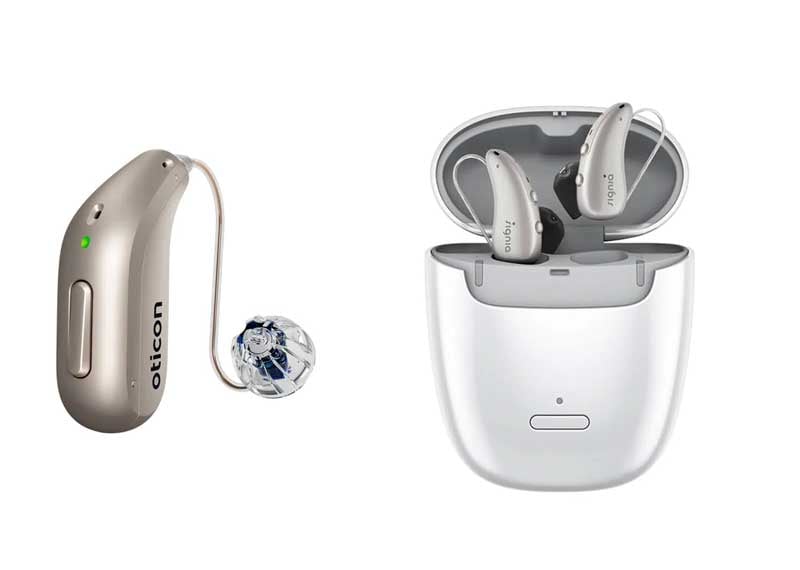

ReSound and Oticon both make premium hearing aids at similar price points, and both market themselves as champions of natural, open sound. Yet in clinic it’s clear they achieve “natural” through fundamentally different routes, and that difference matters more than any spec sheet will admit.
ReSound’s premium hearing aids, particularly with its M&RIE receiver option, lean heavily on preserving the acoustic cues your own ear anatomy creates. Oticon’s premium range, including Intent, uses a deep neural network to analyse the acoustic scene and decide what you should hear more clearly. Same money, same promises about keeping you connected to your environment, but the experience in your ear can be surprisingly different depending on your loss shape and how you actually use your hearing in daily life.
The Real Question: What Does “Natural Sound” Actually Mean?
When patients tell me they want natural sound, they usually mean one of two things. Either they want localisation, the ability to tell where sound is coming from without turning their head, or they want to avoid that hollow, “in a barrel” feeling that comes with aggressive noise reduction. The problem is that hearing aid companies use “natural” to describe both outcomes, even though the engineering required for each is quite different.
ReSound’s approach, particularly when fitted with its M&RIE (Microphone & Receiver-In-Ear) receivers, is to let your outer ear do the work it evolved to do. Instead of placing both microphones in the body of the hearing aid sitting behind your ear, M&RIE puts a third microphone inside your ear canal. This preserves the acoustic filtering your pinna (the visible part of your ear) creates as sound bounces off its folds and ridges. Those reflections contain directional information your brain has been using since infancy to locate sound in three-dimensional space.
In practice, M&RIE is designed to help with front-back discrimination and vertical localisation (telling whether a sound is in front of or behind you, above or below). This matters most for patients who work in complex acoustic environments (open-plan offices, healthcare settings, teachers), people who cycle or walk in traffic, and anyone who’s told me they feel anxious not knowing where their grandchildren are in a room.
Oticon Intent takes a completely different path. It uses a deep neural network trained on a large library of real-world sound scenes to analyse incoming sound, work out what it’s hearing (speech, noise, music, wind) and adjust its processing accordingly. Intent also introduced what Oticon calls 4D Sensor technology, which uses motion sensors and the sound environment to estimate whether you’re moving and whether you’re engaged in conversation, and adjusts its focus to match.
The result is a hearing aid that’s exceptionally good at keeping background sound present and detailed while still prioritising speech clarity. Where ReSound says “we’ll preserve the acoustic cues,” Oticon says “we’ll give you the whole scene and let your brain pick what matters.” For patients with good cognitive function and relatively symmetrical hearing loss, this often translates to good performance in noise without the tunnel-vision effect some directional systems create.
Where the Difference Shows Up in Real Fittings
ReSound with M&RIE tends to suit people who have mild-to-moderate high-frequency loss (the classic noise-induced or age-related pattern), good low-frequency hearing, and who specifically struggle with locating sound or feel disconnected from their environment in their current hearing aids. The M&RIE receiver needs an ear canal that can comfortably take the receiver with its built-in microphone, so not every ear suits it.
The acoustic openness of the fitting is critical to how M&RIE works. If I need to close off your ear canal with a custom mould because you have severe loss or we’re managing feedback, you lose much of the benefit. That’s when an Oticon model such as Intent may be the better fit, because its processing doesn’t depend on preserving ear canal acoustics: it can deliver clarity even in a more occluded fitting.
Oticon’s approach often suits people with moderate-to-severe loss across frequencies, anyone with asymmetric loss (where one ear is significantly worse), and patients who have good speech discrimination scores but struggle in background noise despite well-fitted aids. The 4D sensor system is also designed for people with active lifestyles: it adapts as you move between walking, sitting in conversation, and moving through noisy spaces without the wearer needing to manually switch programs.
Some people prefer Oticon’s processing because it delivers more acoustic information overall; others find that tiring by the end of the day. ReSound’s M&RIE approach leans on your own ear’s natural filtering instead. Which suits you is personal, and it’s one reason a proper trial matters.
The Connectivity and Ecosystem Question
Both brands’ recent premium models support direct streaming from iPhone and many Android phones, and both have moved towards Bluetooth LE Audio and Auracast, the Bluetooth broadcast standard that may in time supplement or replace hearing loops in public venues. Auracast venues are still uncommon, so check your exact model’s support if it matters to you.
App functionality is comparable. ReSound’s app offers sound adjustments and program switching. Oticon’s Companion app includes similar controls, plus extra speech and tinnitus features on supported models. Neither requires the app for basic function, which is worth saying, because some patients assume they’ll need to fiddle with an app all day.
Rechargeable models from both brands are designed to last a full day, though heavy streaming shortens battery life. Both offer disposable battery options in some models if you’re travelling extensively or don’t want charging dependency.
How We Actually Decide in Clinic
When a patient sits in my chair asking “ReSound or Oticon,” I don’t start with brand philosophy. I start with their audiogram, their word recognition scores, and real ear measurement to see how their ear canal resonance will interact with each device. Then I ask about their three most difficult listening situations and what they’re hoping will be different.
If localisation or spatial awareness is in the top three complaints, and their loss and ear anatomy suit M&RIE, a ReSound fitting with M&RIE usually gets the first trial. If their primary struggle is speech clarity in noise, or they have significant low-frequency loss that requires a more closed fitting, an Oticon model such as Intent is often the better starting point.
A trial period, with real ear verification at fitting, tells us more than any amount of theory. Both brands sound excellent when fitted properly, and “properly” means real ear measurement to verify that the gain prescribed by your audiogram is actually reaching your eardrum, not trapped in the tubing or leaked out through a poor fit.
What This Comparison Isn’t
This isn’t a review declaring one brand superior. Both brands’ premium ranges represent excellent engineering, and both will serve most patients with moderate hearing loss extremely well. The differences matter at the margins: in specific use cases, specific anatomies, specific listening priorities.
It’s also not a suggestion that these are your only choices. Phonak, Signia, Starkey, and Widex all make premium devices with their own strengths (our independent guide to hearing aid brands covers them). But patients often land on the ReSound-versus-Oticon question because both brands have staked out the “natural, open sound” territory, and the marketing makes them sound identical when the clinical reality is anything but.
If you’re trying to decide between these two, the honest answer is: you need a proper trial of each, fitted by an independent audiologist with real ear measurement, in your actual listening environments. Anything else is speculation. And if your clinician isn’t offering REM or suggesting you trial both, that’s a bigger problem than which brand logo is on the device.