
Picture a family dinner. Good food, easy talk, nobody in a hurry. Then a fourteen-year-old girl stands up, takes her plate, and walks to her room without a word. Her father was chewing. That was all. He was not loud, he was not rude, he was eating a piece of chicken the way he has eaten chicken for fifty years. To his daughter that sound sat somewhere between an insult and a slap, and her body had already decided, before any thought could reach it, that she needed to be out of the room.
If you love someone with misophonia, you have watched a version of that scene. You may have been the one chewing. You may have felt the sting of it, the sense that your own eating, breathing, or the click of your pen has turned you into the villain of an ordinary evening. Before you can help, it helps to understand what actually happened at that table.
What misophonia is, and what it is not
Misophonia is a lowered tolerance for particular sounds, usually small, repetitive, pattern-based ones, and very often ones that come out of another human body. Chewing. Sniffing. Throat-clearing. Lip-smacking. Heavy breathing. A tapping foot, a clicking pen, keys on a keyboard. Loudness is beside the point. A whisper of a crunch across a quiet room can do more damage than a passing truck. The response is not irritation turned up a few notches. It is a fight-flight-freeze surge: anger, disgust, sometimes panic, and a physical pull to either escape the sound or stop it at the source. People describe wanting to scream, to leave, to cover their ears, occasionally to lash out, and then feeling ashamed of the size of a reaction they never chose.
The term misophonia was introduced by audiologists Pawel and Margaret Jastreboff in the early 2000s to describe strong negative reactions to particular sounds that could not be explained by their loudness alone. But for the next two decades, researchers and health professionals used different definitions and criteria to describe the condition. It was not until 2022 that misophonia received its first expert consensus definition, when an international committee of researchers and clinicians published an agreed definition in Frontiers in Neuroscience. That is remarkably recent. It means many people with misophonia, and the parents and partners around them, spent years trying to make sense of something that had a name but no widely agreed clinical definition. Awareness among health professionals is still developing. It is happening in the brain, not in bad manners
Here is the part worth holding onto when you are tempted to take it personally. Brain imaging led by Sukhbinder Kumar and colleagues found that trigger sounds light up the anterior insula, a region that decides what deserves your urgent attention, and that this region talks unusually strongly to the orofacial motor cortex, the patch of brain that would control your own mouth and jaw if you were the one chewing. Read that again. When your daughter hears you eat, part of her brain reacts almost as if it were being made to perform the chewing itself. The leading explanation is a kind of overactive mirroring. Her nervous system will not let the sound stay in the background where it belongs. One more detail matters. The amygdala, the brain’s fear alarm, is not the headline actor here, which is why treating misophonia as plain anxiety tends to miss. This is closer to a hardwired sensory-motor reflex than to a worry that can be reasoned away. Your loved one is not being fussy, defiant, or manipulative. Their brain is doing something they did not ask it to do.
The trap that catches loving families
Now the hard part, and the reason this article exists.
Researchers at Baylor College of Medicine studied more than a hundred children and teenagers with misophonia and compared their families to families of anxious children. They found that parents of misophonic kids adjust their lives constantly. More than seventy per cent modify household routines, help the child avoid triggers, and take part in the workarounds. That rate was higher than in families dealing with anxiety disorders. The children also became more distressed and angry when a parent did not accommodate them.
Every one of those parents was doing something loving. You move dinner to a different room. You eat separately. You stop clicking the pen, stop humming, in one striking case stop speaking normally because your own voice has become a trigger. Each concession buys a calmer evening. It is a fair trade tonight.
The problem is what those trades add up to over a year. Borrow the lesson from anxiety and OCD treatment: accommodation that soothes the moment can quietly teach avoidance, and avoidance shrinks a person’s world. The child who eats alone every night does not learn that a family meal is survivable. The teenager who is excused from every noisy room never builds the tolerance to sit an exam next to a sniffer, or to eat at a friend’s house, or to keep a job in an open-plan office. Relief now, a smaller life later.
So the goal is not to strip every trigger out of the house. It is to help the person carry more, while keeping the household livable for everyone who also lives in it.
#image_title
What actually helps
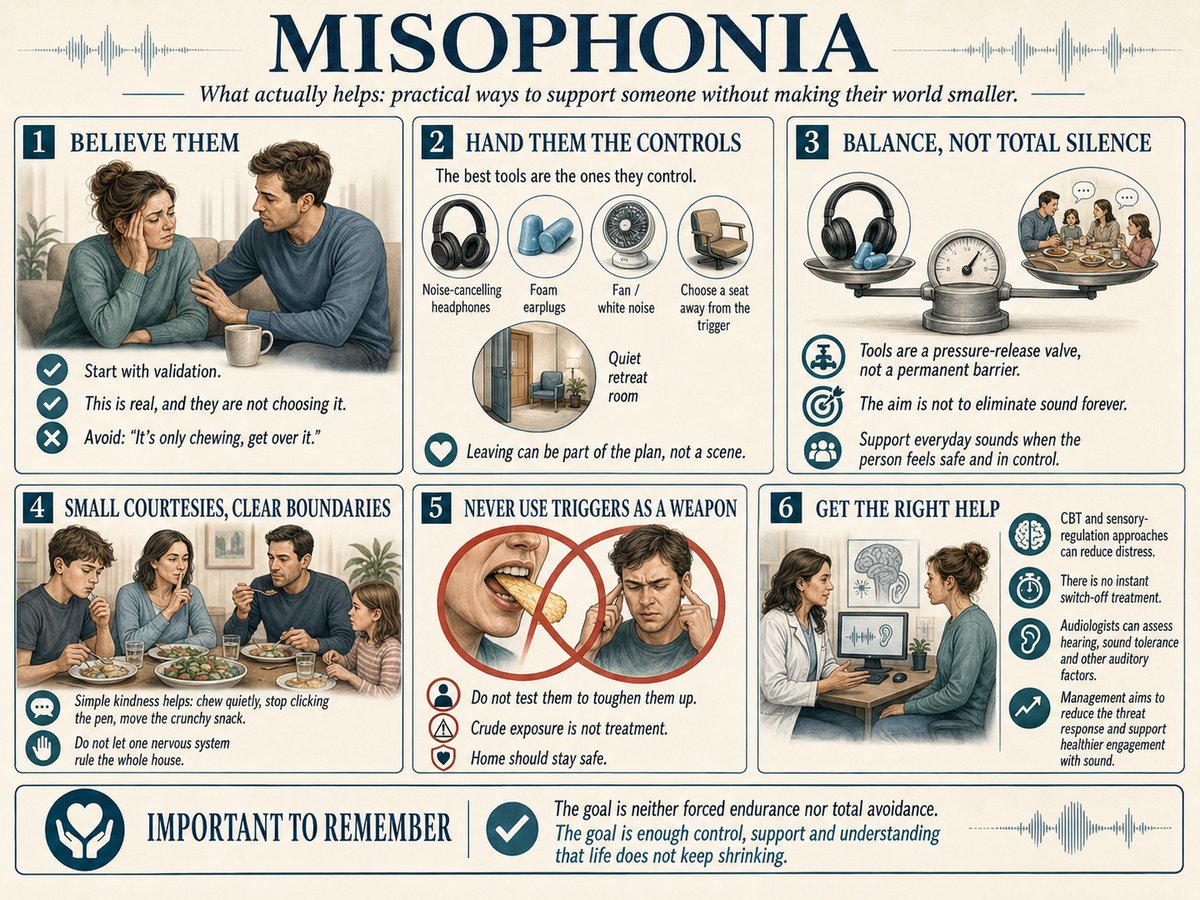
Believe them, first and without argument. The single most wounding thing you can say is “it’s only chewing, get over it.” You would not tell someone their migraine is only a headache. Start from “I know this is real and I know you are not choosing it.” Validation is not the same as surrender, and it costs you nothing.
Hand them the controls. The tools that work best are the ones your loved one operates themselves rather than ones you impose. Noise-cancelling headphones. Foam earplugs. A fan or a bit of white noise to take the edge off a trigger. A seat where they cannot see the trigger, because chewing and other mouth movements can set people off through the eyes as well as the ears. A room they can retreat to when it becomes too much, agreed in advance so leaving is a plan and not a scene.
But there is an important balance here. The goal is not to eliminate sound from their life. Headphones, earplugs and quiet spaces can be enormously useful when someone is overwhelmed, but relying on them all the time can create its own problems. We do not want to build a world in which silence becomes the only place that feels safe and ordinary sounds are increasingly treated as threats. Think of these tools as a pressure-release valve rather than a permanent barrier: something your loved one can choose when they need it, while still having opportunities to experience everyday sounds in situations where they feel safe, supported and in control. The aim is not to force them to endure trigger sounds, nor to protect them from every possible sound. It is to give them enough control and support that their world does not have to keep getting smaller.
Offer small courtesies, but do not let them become law. Closing your mouth when you eat, putting the pen down, taking the crunchy snack to another room: these are ordinary kindnesses and worth doing. The line to watch is the one between a reasonable request and the whole family rearranging itself around one nervous system. Cross that line and you are back in the trap.
Keep an eye on everyone else at the table. Siblings notice when one child’s needs run the house, and partners quietly keep score. Resentment left to simmer will poison the very relationships your loved one needs most. Name it, share the load, and do not pretend the cost falls on no one.
Never use the trigger as a weapon and never test them to toughen them up. Deliberately chewing at someone to make a point, or forcing exposure to “get them used to it,” is not treatment. Crude exposure does not work the way it does for a spider phobia, and it teaches your loved one that home is not safe.
Get the right professional help and be honest about its limits. Cognitive behavioural approaches and sensory-regulation strategies can help reduce distress and the impact misophonia has on everyday life, but there is no treatment that simply switches the response off. An audiologist can play an important role by assessing hearing and broader sound tolerance, identifying other auditory factors that may be contributing, and helping the person understand why their auditory system may be reacting so strongly. Management can draw on a neurophysiological model: the problem is not simply the sound itself, but the powerful connections that can develop between particular sounds and the brain’s emotional and autonomic responses. Audiological management aims to reduce that threat response and support healthier engagement with sound, rather than simply blocking or avoiding it.
Back to the table
The aim is not a house with no chewing in it. Silence bought that way is its own kind of loss. The aim is a daughter who can sit at the dinner she wants to leave, headphones within reach, a door she is allowed to use, and a father across the table who understands that her walking out was never about him. Some nights she will make it to dessert. Some nights she will not. On the nights she does, resist the urge to announce it or to make her prove she can do it again tomorrow. Pass the salt, keep talking, and let the evening stay bigger than the sound.
Sources and further reading
Gregory, J., Graham, T., & Hayes, B. (2024). Targeting beliefs and behaviours in misophonia: A case series from a UK specialist psychology service. Behavioural and Cognitive Psychotherapy, 52(1), 94–111. https://doi.org/10.1017/S1352465823000462
Gregory, J. (2023). Sounds like misophonia: How to stop small noises from causing extreme reactions. Green Tree.
Jastreboff, P. J., & Jastreboff, M. M. (2023). The neurophysiological approach to misophonia: Theory and treatment. Frontiers in Neuroscience, 17, 895574. https://doi.org/10.3389/fnins.2023.895574
Kumar, S., Dheerendra, P., Erfanian, M., Benzaquén, E., Sedley, W., Gander, P. E., Lad, M., Bamiou, D.-E., & Griffiths, T. D. (2021). The motor basis for misophonia. The Journal of Neuroscience, 41(26), 5762–5770. https://doi.org/10.1523/JNEUROSCI.0261-21.2021
Kumar, S., Tansley-Hancock, O., Sedley, W., Winston, J. S., Callaghan, M. F., Allen, M., Cope, T. E., Gander, P. E., Bamiou, D.-E., & Griffiths, T. D. (2017). The brain basis for misophonia. Current Biology, 27(4), 527–533. https://doi.org/10.1016/j.cub.2016.12.048
Storch, E. A., Guzick, A. G., D’Souza, J., Clinger, J., Ayton, D., Kook, M., Rork, C., Smith, E. E., Draper, I. A., Khalfe, N., Rast, C. E., Murphy, N., Lijfijjt, M., Goodman, W. K., & Cervin, M. (2024). Family accommodation in children and adolescents with misophonia. Behavior Therapy, 55(3), 595–604. https://doi.org/10.1016/j.beth.2023.09.001
Swedo, S. E., Baguley, D. M., Denys, D., Dixon, L. J., Erfanian, M., Fioretti, A., Jastreboff, P. J., Kumar, S., Rosenthal, M. Z., Rouw, R., Schiller, D., Simner, J., Storch, E. A., Taylor, S., Vander Werff, K. R., Altimus, C. M., & Raver, S. M. (2022). Consensus definition of misophonia: A Delphi study. Frontiers in Neuroscience, 16, 841816. https://doi.org/10.3389/fnins.2022.841816