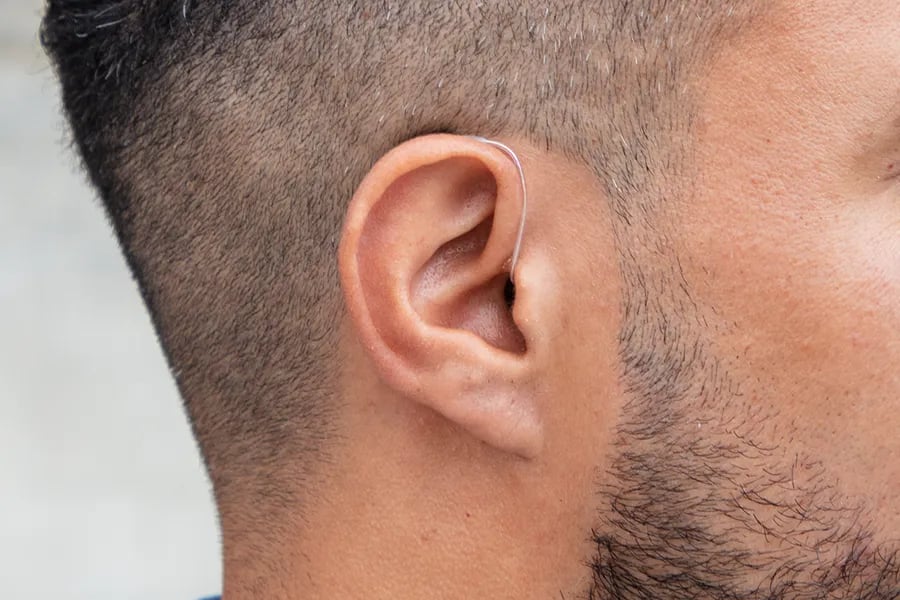

Most people who start wearing hearing aids notice the same things in the first week. The kettle is too loud, paper rustles sharply, cutlery clatters and their own voice sounds hollow. None of this usually means the aids are wrong. The brain is receiving sounds it hasn’t processed clearly for years, and it has to relearn what normal sounds like.
Our guide to your first 30 days with hearing aids sets out a practical week-by-week plan. This article looks at what is happening in the brain while you work through it.
What untreated hearing loss does to the brain
The brain allocates its resources according to use. When the auditory cortex receives less input, other senses can start to take over some of its capacity, a process called cross-modal reorganisation. Julia Campbell and Anu Sharma at the University of Colorado reported in 2014 that in adults with even mild-to-moderate age-related hearing loss, visual stimuli activated auditory areas of the brain more than in people with normal hearing. In later work from the same lab, more reorganisation went with poorer understanding of speech in noise.
In 2020, Hannah Glick and Anu Sharma fitted 28 adults with mild-to-moderate loss with hearing aids and retested them after six months. The visual recruitment of auditory cortex had partly reversed, and the group showed better speech perception in noise and improvements on some cognitive measures. It was a small study without a randomised control group, so it shows that this kind of plasticity is possible in older adults without telling us how much any individual will gain. It is still good evidence that the adult brain can reorganise back towards sound when it gets the input.
Why new hearing aids sound tinny and harsh
Age-related and noise-induced hearing loss usually affect high frequencies first and progress slowly. Over the years the brain adjusts its idea of normal to a world with little high-frequency sound. Hearing aids bring those frequencies back. That restores the consonants that make speech clear, along with the hiss of air conditioning, the crinkle of plastic and the scrape of a chair. Against the brain’s old baseline they sound unnaturally sharp, even when the levels are correct.
The central auditory system also has a form of automatic gain control. When input has been reduced for a long time, the brain turns up its internal sensitivity. Experiments in people with normal hearing show how quickly this can happen. In a 2003 study by Craig Formby and colleagues, adults who wore earplugs continuously for two weeks rated sounds as louder than before they started. A new hearing aid user meets restored sound with that internal gain still turned up, and it takes time to settle.
Your own voice
Your own voice reaches your cochlea through the air and through the bones of your skull. With the ear canal open, much of the low-frequency bone-conducted sound escapes. A hearing aid dome or mould partly blocks the canal and traps that energy, which can boost your own voice at low frequencies by 20 dB or more. This is the occlusion effect, and it causes the “talking in a barrel” sensation. Some of it fades as you adjust. If it doesn’t, a more open fitting or a larger vent can often reduce it. We explain the acoustics in the occlusion effect.
What the acclimatisation research shows
The idea that aided benefit grows over time with no change to the settings is called acclimatisation. Stuart Gatehouse, at the MRC Institute of Hearing Research in Glasgow, reported in 1992 that people fitted with one hearing aid showed a gradual improvement in speech recognition in the aided ear over several weeks, with no matching change in the ear left unaided. Later studies have produced mixed results. Some found clear improvement over a few months, others found small or inconsistent effects, and the size of the change seems to vary between people and with how it is measured.
Two findings are more consistent. Most people report that sound quality becomes more acceptable over the first weeks, and people who wear their aids for more hours each day tend to report more benefit. Wear time is one of the few factors a new user controls directly.
Giving your brain the input it needs
- Wear the aids from waking until bedtime. The brain adapts to consistent input. An hour in the evening gives it little to work with.
- Move from easy to harder settings. Start with quiet conversation at home, then add the car, the shops and family meals. Avoiding noisy places altogether delays adapting to them.
- Tell “unfamiliar” apart from “uncomfortable”. New sounds that are strange but tolerable usually fade into the background. Sounds that hurt, make you flinch or make you take the aids out are worth reporting.
- Use your follow-up appointments. Some people start below their full prescribed gain and step up over a few visits. Data logging in the aids shows your audiologist your daily wear time and the kinds of environments you have been in, which makes each adjustment more precise.
When it isn’t acclimatisation
Some problems won’t improve with time: soreness in the ear, a dome or mould that won’t stay seated, whistling feedback, one aid noticeably weaker than the other, or no improvement after several weeks of full-time wear. These need a fitting check, and sometimes a recheck of hearing and middle ear function. Sudden hearing loss, new tinnitus in one ear, dizziness or discharge from the ear need prompt medical assessment.
Fitting accuracy matters here too. If the hearing aids deliver less gain than prescribed at the frequencies that carry speech clarity, waiting for the brain to adapt won’t fix it. Real-ear measurement checks the sound actually reaching your eardrum, so adaptation starts from a verified fitting. See our commitment to real-ear measurement and how often hearing aids need adjusting.