

A tour of animal hearing and what a fish gill has to do with the folds on the side of your head.
An elephant flaps its ears to cool the blood running through them. A barn owl finds a mouse in complete darkness using ears set at different heights on its skull. A drab little insect called the greater wax moth, the kind you would swat without a second look, hears higher pitches than any animal ever tested. And the folded flap of cartilage on the side of your head, the part you have probably never thought about, started its evolutionary life as a fish gill.
That last point is not a figure of speech. It comes from a 2025 study from the University of Southern California, published in Nature, which found that the outer ear develops using the same set of genetic instructions that build gills in fish and amphibians. The team even took a gene switch from a horseshoe crab gill, dropped it into a zebrafish, and watched it switch on gill tissue. As the lead researcher put it, the middle ear came from old fish jawbones, and the outer ear came from cartilaginous gills. Your ear is a repurposed breathing organ.
Ears are one of evolution’s favourite things to tinker with. Across the animal kingdom, they come in shapes that look as if designed by committees that never spoke to each other, because, in a sense, they were. Each shape is a compromise between jobs that pull in different directions: catching sound, working out where it came from, staying cool, staying hidden, and sometimes not being an ear at all. Here is the tour.
Only mammals have the ear you are picturing
When most people say “ear” they mean the pinna, the visible flap. It is worth noting that this structure is found only in mammals. Birds, reptiles and frogs have eardrums, but theirs sit flush against the head with nothing sticking out. Fish have no external ear whatsoever. So, the whole business of ears that flap, swivel, prick up and droop is a mammalian speciality, and it is a young one in evolutionary terms.
The pinna does three things. It funnels sound into the ear canal, boosting some frequencies as it goes. It colours that sound depending on the direction it arrives from, which is how the brain tells whether a noise came from above or below. And in most mammals, it moves, aiming itself at whatever is worth listening to. Humans kept the first two jobs and mostly gave up the third, which is why the muscles that would let you waggle your ears are still there but generally useless.
Ears that point
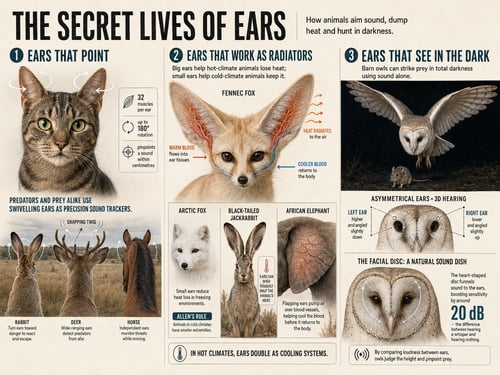
Watch a cat track a sound, and you are watching precision engineering. Each of a cat’s ears is worked by 32 muscles, against the six sad remnants in a human ear. It can rotate each one up to 180 degrees, aim them independently, and pin down the source of a noise to within a few centimetres from across the room. One ear can face forward while the other sweeps behind, which is how a hunting animal keeps tabs on prey ahead and threats behind at the same time.
Prey animals run the same equipment for the opposite reason. Rabbits, hares, deer and horses all carry tall, cupped, swivelling ears that work as an early warning system. The ears are usually the first part of the animal to react, turning toward a snapped twig long before the head follows.
Ears that work as radiators
In hot countries, ears do a second job unrelated to hearing. The fennec fox of the Sahara has the largest ears of any fox relative to its body, roughly 9 centimetres on an animal that weighs about a kilogram. Those ears make up close to a fifth of its total skin surface, and they are packed with blood vessels sitting just under thin skin. Warm blood flows out to the ears, sheds heat into the air, and returns cooler. The same animal in the Arctic runs the design in reverse: the Arctic fox has small, rounded, well-insulated ears that give heat almost nowhere to escape. This pattern, bigger appendages in warmer climates, has a name in biology, Allen’s rule, and it has held up since 1877.
The black-tailed jackrabbit takes the radiator idea to an extreme. It cannot afford to pant away its water in the desert, so instead it points its enormous, paper-thin ears at the cool open sky and lets heat pour off them. One classic calculation found that the ears alone could dump roughly half of the animal’s heat production. The elephant is the giant version of the same trick. African elephants evolved far bigger ears than their Asian relatives, matching hotter, more open country, and you can see the map of the large blood vessels running across them. An elephant flapping its ears on a hot day is not fanning itself so much as running a cooling system, and blood leaving the ears can be several degrees cooler than blood arriving.
Ears that see in the dark
The barn owl is the finest sound-locator in the animal world, and it cheats in a way no mammal does. Its two ear openings are not level. The left sits higher and points slightly down; the right sits lower and points slightly up. A sound coming from below is louder in one ear; a sound from above is louder in the other. That lopsided arrangement turns loudness into a reading of height, so the owl can locate a mouse in the vertical plane as precisely as it can from side to side.
Then there is the face. The owl’s flat, heart-shaped facial disc is a ruff of stiff feathers that works like a satellite dish, gathering faint sound and steering it toward the ears. Researchers who digitally removed the ruff in acoustic models found it adds around 20 decibels of sensitivity and sharpens direction-finding in both planes. A barn owl can strike a mouse in total darkness on sound alone. The face is doing much of the listening.
The bat’s acoustic toolkit
Bats hear the world by shouting at it and reading the echoes, and their ears are shaped to make sense of the returns. Many have a small pointed flap in front of the ear canal called the tragus. In the big brown bat, this little flap lets the animal judge how high or low a target sits: with the tragus in place, it can resolve angles as fine as 3 degrees, and bending it out of the way blurs that to around 12 degrees.
Horseshoe bats went further and rebuilt both the transmitter and the receiver. They call through their nostrils, which are framed by an elaborate, fleshy structure called a noseleaf that shapes the outgoing beam of sound. They can flex both the noseleaf and the ears in about a tenth of a second, faster than you can blink, tuning the beam and the reception on the fly. Other bats simply grew huge ears. The brown long-eared bat has ears nearly as long as its entire body, which it curls back like a ram’s horns when it sleeps. North America’s spotted bat is stranger still: its echolocation calls are low enough for a human to hear, and low enough that most moths cannot. A moth that would pick up a big brown bat from 20 metres away may not notice a spotted bat until it is about a metre off. The oversized ears gather the faint echoes that this stealth approach leaves behind.
The moth that out-listened the bat
This is where the arms race gets absurd. Moths are prey for echolocating bats, so many moths evolved ears tuned to hear bats approaching. Bats pushed their calls higher to stay quiet; moths pushed their hearing higher to keep up. The current champion is the greater wax moth, which can detect frequencies approaching 300 kilohertz, the highest hearing ever recorded in any animal. For comparison, the top of human hearing is about 20 kilohertz, and the highest known bat calls reach around 212 kilohertz. The moth simply climbed past them.
The organ doing this is almost nothing. The wax moth’s ear is about half a millimetre across and contains just four sensory cells. There is no known biological reason it needs to hear that high beyond staying one step ahead of a predator that has not caught up yet.
The low end: rumbles you cannot hear
At the opposite end of the dial, elephants specialise in sound too low for human ears. Their hearing extends down to around 17 hertz, below the lower end of the human range, and they use deep rumbles to communicate over long distances. Some of that call travels through the ground as a vibration, and elephants pick it up through the sensitive skin of their feet and trunk. In one field experiment, an alarm call played through the ground alone, with no sound in the air, was enough to make a herd bunch together and move off. They were feeling the message through their feet.
Hearing underwater, without any ears
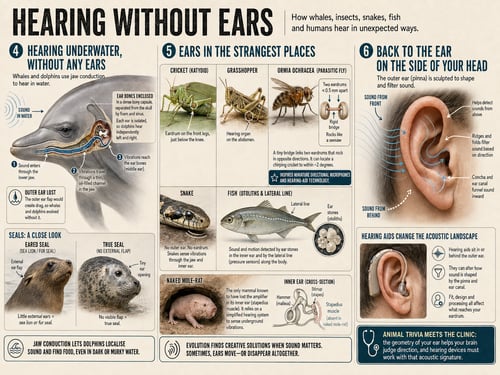
Whales and dolphins threw the whole design out. A flap sticking off the head is useless underwater and only creates drag, so they lost the pinna entirely and re-routed hearing through bone. A dolphin picks up sound through a thin, oil-filled channel in its lower jaw, which carries the vibration back to the ear bones. Those bones, sealed in a dense capsule, have detached from the rest of the skull and float in a cushion of foam and sinus, so each ear hears independently. That separation is what lets a dolphin determine direction in a medium where sound travels four and a half times faster than in air.
Seals kept a foot in both worlds and split into two camps you can tell apart by the ear. Sea lions and fur seals, the “eared seals”, still have a small visible flap. True seals lost the flap and kept only a pinhole, along with plumbing tuned for hearing underwater. If it has little ears on the outside, it is a sea lion; if it looks earless, it is a seal.
Ears in the strangest places
Plenty of animals hear with no ears at all, or with ears in places that seem like a joke. Crickets and katydids have their eardrums on their front legs, just below the knee. Grasshoppers keep theirs on the abdomen. A parasitic fly called Ormia ochracea has two eardrums sitting less than half a millimetre apart, which should make it hopeless at telling direction, and yet it can locate a chirping cricket to within 2 degrees. It manages this with a tiny rigid bridge connecting the two eardrums, letting them rock like a see-saw and exaggerate the minuscule difference between them. Engineers have since copied the mechanism to build small directional microphones, including for hearing aids. The fly solved a problem that human technology is still borrowing from.
Snakes have no outer ear and no eardrum. They rest the jaw on the ground and read vibrations through a bone that links the jaw to the inner ear, sensitive enough to pick up ground movement finer than the width of an atom. Fish hear using dense “ear stones” that lag behind the vibrating body and tug on sensory hairs, backed up by the lateral line running along their flanks that senses water moving nearby. And the naked mole-rat, which lives in dark, noisy, echoing tunnels, went the other way entirely and let its hearing fall apart. It is the only mammal known to have lost the amplifier in its inner ear, which may be a mercy given how loud its own burrows are.
Back to the ear on the side of your head
Next to a barn owl or a fennec fox, the human ear looks unremarkable. It does not swivel, it is not huge, and it does not cool your blood. But those ridges and folds are not decoration. They filter incoming sound in a way that depends on the direction it came from, and the pattern of that filtering is unique to the exact shape of your ear. It is one of the main reasons you can tell a sound above you from a sound below you with your eyes shut. Your brain learned the acoustic signature of your own two ears in infancy and has trusted it ever since.
This is where animal trivia meets the clinic. When a hearing aid sits in or behind the ear, it changes those natural acoustics. It reshapes the sound before it reaches the eardrum, and the shape it produces depends on the size of the ear canal, the angle of the folds, and the fit of the device. Two people with identical hearing loss and identical hearing aids can end up with very different sounds reaching their eardrums. The only way to know what is actually arriving down there is to measure it in the ear itself. That is what Real Ear Measurements do, and it is why The Audiology Place runs it as standard on every fitting rather than trusting the numbers a manufacturer prints on a box.
Evolution spent a long time shaping the ear on the side of your head. It seems worth measuring what your hearing aid does to it.
The Audiology Place is a fully independent audiology clinic in Forestville and Epping, serving Sydney’s Northern Beaches and the wider city. Every assessment lasts at least 60 minutes, and Real Ear Measurement comes standard with every fitting. Book an appointment at theaudiologyplace.com.au or call (02) 9315 8327.
References:
Christensen-Dalsgaard, J., & Jørgensen, M. B. (1996). Sound localisation and directional hearing in terrestrial vertebrates. Naturwissenschaften, 83, 338–344.
Heffner, R. S., & Heffner, H. E. (1982). Hearing in the elephant (Elephas maximus): Absolute sensitivity, frequency discrimination, and sound localisation. Journal of Comparative and Physiological Psychology, 96(6), 926–944. https://doi.org/10.1037/h0077941
Hill, K. G., & Boyan, G. S. (1976). Directional hearing in crickets. Nature, 261, 390–391.
Köppl, C., Gleich, O., & Manley, G. A. (2000). An auditory fovea in the barn owl cochlea. Journal of Comparative Physiology A, 186, 917–929.
Mason, M. J., Cornwall, H. L., & Smith, E. S. J. (2016). Ear structures of the naked mole-rat, Heterocephalus glaber, and its relatives (Rodentia: Bathyergidae). PLoS ONE, 11(12), e0167079. https://doi.org/10.1371/journal.pone.0167079
Moir, H. M., Jackson, J. C., & Windmill, J. F. C. (2013). Extremely high frequency sensitivity in a “simple” ear. Biology Letters, 9(4), 20130241. https://doi.org/10.1098/rsbl.2013.0241
Müller, R. (2004). A numerical study of the role of the tragus in the big brown bat. Journal of the Acoustical Society of America, 116(6), 3701–3712.
Narins, P. M., Lewis, E. R., Jarvis, J. J. U. M., & O’Riain, J. (1997). The use of seismic signals by fossorial southern African mammals: A neuroethological gold mine. Brain Research Bulletin, 44(5), 641–646.
National Oceanic and Atmospheric Administration Fisheries. (n.d.). Seals & sea lions. https://www.fisheries.noaa.gov/seals-sea-lions
Robert, D., Miles, R. N., & Hoy, R. R. (1996). Directional hearing by mechanical coupling in the parasitoid fly Ormia ochracea. Journal of Comparative Physiology A, 179, 29–44.
Smithsonian’s National Zoo & Conservation Biology Institute. (n.d.). Fennec fox. https://nationalzoo.si.edu/animals/fennec-fox
Thiruppathy, M., et al. (2025). Repurposing of a gill gene regulatory program for outer-ear evolution. Nature. https://doi.org/10.1038/s41586-024-08577-5
West, C. D. (1985). The relationship of the spiral turns of the cochlea and the length of the basilar membrane to the range of audible frequencies in ground dwelling mammals. Journal of the Acoustical Society of America, 77(3), 1091–1101.
Wohlgemuth, M. J., Kothari, N. B., & Moss, C. F. (2016). Action enhances acoustic cues for 3-D target localization by echolocating bats. PLoS Biology, 14(9), e1002544. https://doi.org/10.1371/journal.pbio.1002544
Zeyl, J. N., den Ouden, O., Köppl, C., Assink, J., & Christensen-Dalsgaard, J. (2020). Infrasonic hearing in birds: A review. Hearing Research, 395, 108019. https://doi.org/10.1016/j.heares.2020.108019