
When you’re fitted with hearing aids, one of the most important, yet often overlooked, decisions your audiologist makes is how the device sits in your ear canal. Should it be open, allowing natural sound to flow in and out? Or closed, sealing the canal completely? This choice between open fit vs closed fit hearing aids, and the corresponding selection of hearing aid domes versus custom earmoulds, has profound implications for how you hear the world and, crucially, how you hear yourself.
Understanding this balance, often called the occlusion trade-off, can mean the difference between hearing aids you wear happily all day and devices that sit in a drawer.
What Is the Occlusion Effect and Why Does It Matter?
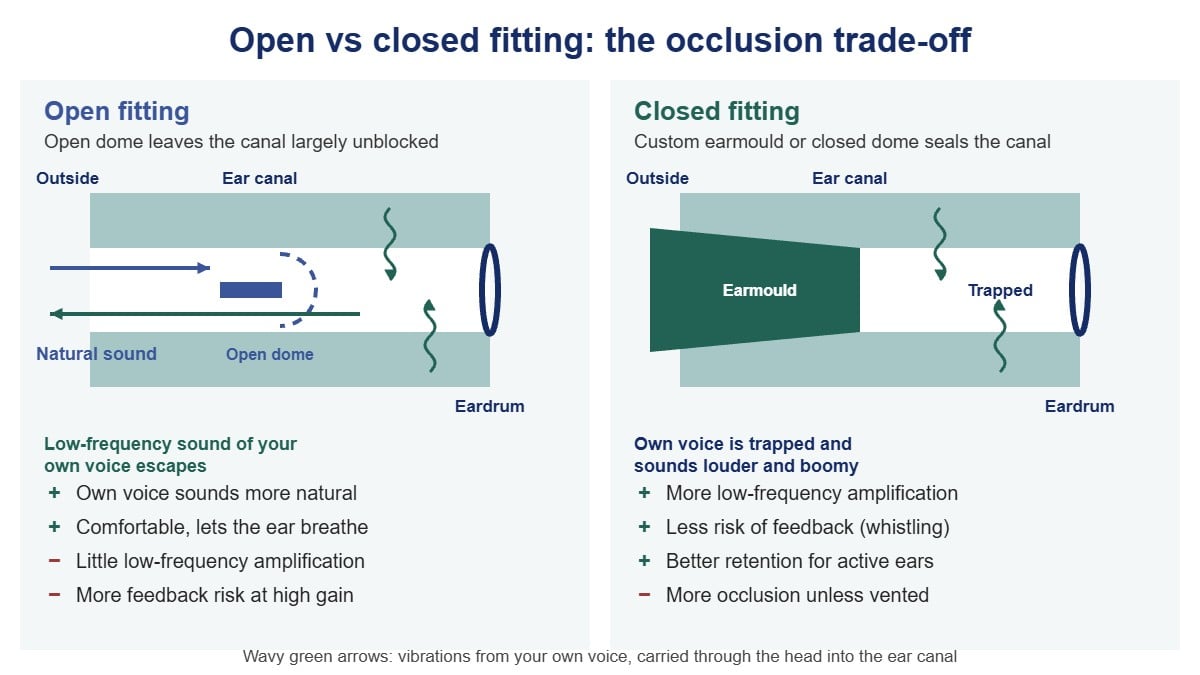
The occlusion effect occurs when your ear canal is blocked, whether by a hearing aid, earmould, or even your finger. When you speak, chew, or hum, vibrations from your jaw and skull normally escape through the open ear canal. When that pathway is sealed, those low-frequency vibrations become trapped, making your own voice sound hollow, booming, or as though you’re speaking inside a barrel.
This sensation can be deeply uncomfortable. Occlusion is a well-known reason new hearing aid users struggle to settle into their devices. The effect is most pronounced for people with good low-frequency hearing: ironically, often those with mild-to-moderate high-frequency hearing loss who would otherwise be excellent candidates for amplification.
The audiologist’s task is to balance the need for acoustic seal (which improves amplification, reduces feedback, and delivers low-frequency sound) against the comfort of an open fitting that preserves your natural voice quality and allows environmental sounds to enter unobstructed.
Open Fittings and Vented Domes: When Less Is More
An open fitting typically uses a soft silicone dome with large vents or, in some cases, a slim tube with almost no occlusion at all. These fittings are often the first choice for individuals with mild-to-moderate high-frequency hearing loss and relatively normal hearing below 1000 Hz.
Advantages of Open Fittings
Open fittings preserve the natural acoustic properties of the ear canal. Low-frequency sounds, including your own voice, reach the eardrum directly without amplification. This maintains a sense of naturalness and reduces the occlusion effect significantly. Many patients report that open fittings feel more comfortable and less intrusive, particularly during the critical first weeks of adaptation.
Additionally, open domes allow air circulation, which can reduce moisture build-up and irritation, a useful consideration in Sydney’s humid summers. For active individuals or those who perspire heavily, this breathability can improve long-term wearing comfort.
Limitations and Trade-Offs
The primary limitation of open fittings is that low-frequency amplification is limited. Sound leaks out through the vents, which can also create a feedback loop if high levels of amplification are required. For individuals with more substantial low-frequency hearing loss, an open fitting may leave them under-aided, missing important speech cues like vowel sounds and environmental alerts such as traffic noise or warning signals.
Real ear measurement (REM), a verification procedure in which a probe microphone measures sound levels inside your ear canal while you wear the hearing aid, is essential for determining whether an open fitting provides adequate amplification across frequencies. At a thorough audiology appointment, your clinician should always verify fitting adequacy with REM rather than relying on manufacturer defaults alone.
Closed Fittings and Custom Earmoulds: Maximum Performance, Greater Adaptation
A closed fitting uses either a sealed dome or a custom earmould that fills the ear canal (or concha, depending on style) with minimal venting. This approach is necessary when:
- Hearing loss extends into the low frequencies
- High gain is required, increasing feedback risk
- The patient needs maximum speech intelligibility in noise
- Retention is an issue (domes falling out or not staying secure)
The Role of Vent Size in Managing Occlusion
Even within closed fittings, vent size is adjustable. A custom earmould can be made with a small vent that releases some low-frequency energy and reduces occlusion, while still providing enough seal for effective amplification and feedback control.
The relationship between vent size and acoustic effect isn’t linear. Even a modest vent can reduce occlusion noticeably, but it also lets low-frequency amplification escape and increases the chance of feedback. Your audiologist balances the two, using the fitting software and REM to check the result in your ear canal. Our article on hearing aid vent size goes into more detail.
For individuals with profound low-frequency loss, a completely closed mould with no vent may be necessary. In these cases, the occlusion effect is less bothersome because the patient’s residual hearing in that frequency range is minimal: they simply don’t perceive the trapped vibrations as intensely.
Hearing Aid Domes vs Custom Earmoulds: Practical Considerations
When Domes Are Appropriate
Hearing aid domes are prefabricated, come in multiple sizes (small, medium, large) and styles (open, closed, power), and can be fitted instantly. They’re cost-effective, easy to replace, and ideal for:
- First-time users trialling amplification
- Patients with standard ear canal shapes
- Mild-to-moderate losses without significant low-frequency involvement
- Situations requiring quick turnaround (same-day fittings)
Domes should be replaced every one to three months, depending on wear and hygiene. Wax build-up, tearing, or hardening of the silicone are signs it’s time for a change. Always keep spare domes on hand: your audiologist should provide several at your fitting appointment.
When Custom Earmoulds Are Necessary
Custom earmoulds require an impression of your ear canal, laboratory fabrication, and a greater upfront cost. However, they offer:
- Superior retention: Essential for individuals with active lifestyles, very narrow or unusually shaped canals, or those who have had domes fall out repeatedly
- Precise acoustic control: Venting, canal length, and material hardness can all be tailored
- Durability: A well-made acrylic or silicone mould can last several years with proper care
- Maximum gain without feedback: Critical for severe-to-profound losses
Earmoulds should be inspected at every follow-up appointment and replaced when tubing hardens, the material cracks, or your ear anatomy changes (weight loss, ageing, or surgical intervention can all alter ear canal shape).
Coaching Through the Adaptation Period: What to Expect
Whichever fitting style you start with, adaptation takes time. The auditory system needs weeks, sometimes months, to recalibrate. Here’s what your audiologist should discuss:
Initial Acclimatisation
For the first few days, even an open fitting may feel strange. Sounds you haven’t heard in years (rustling paper, footsteps, the fridge humming) can seem unnaturally loud. Your voice may sound different even with maximum venting. This is normal.
Your clinician may program your hearing aids to start a little below the full prescription and step up gradually over several weeks. Many people find this gentler start easier to accept.
When to Request a Change
If occlusion remains intolerable after two to three weeks, or if you’re struggling to understand speech because low frequencies are under-amplified, contact your audiologist. Options include:
- Switching from a closed dome to a more open style
- Adding or enlarging a vent in a custom mould
- Adjusting the depth of insertion (deeper fittings often reduce occlusion)
- Exploring receiver-in-canal (RIC) devices with different power receivers
Follow-Up and Real Ear Verification
Expect several follow-up appointments in the first few months. These sessions allow for fine-tuning based on your real-world experience and verification that the fitting meets evidence-based targets (such as NAL or DSL prescriptions) via REM.
Red Flags and When to Seek Immediate Help
While adaptation discomfort is expected, certain symptoms warrant prompt attention:
- Pain or persistent soreness: May indicate an ill-fitting mould or dome, or an underlying ear infection
- Sudden hearing loss or fullness: Could signal wax impaction, a middle ear problem or sudden sensorineural hearing loss, which needs urgent medical assessment
- Drainage, odour, or itching: Possible infection or allergic reaction to mould material
- Constant feedback (whistling): Suggests poor seal or incorrect programming, both of which reduce benefit and should be corrected
Always err on the side of caution. A quick check-in with your audiologist, or your GP if the practice is closed, can prevent complications and preserve your confidence in the rehabilitation process.
The Bottom Line: Personalisation Is Everything
There is no universally “best” choice between open and closed fittings, or between domes and earmoulds. The optimal solution depends on your unique hearing loss configuration, ear anatomy, lifestyle demands, and tolerance for occlusion. A skilled audiologist will walk you through the trade-offs, verify every fitting with objective measures like REM, and support you through the adaptation journey with patience and evidence-based adjustments.
At The Audiology Place, we take a brand-agnostic, patient-centred approach. Our goal is not simply to fit a device, but to optimise your hearing health and quality of life over the long term. If you’re uncertain whether your current fitting is right for you, or if you’re considering hearing aids for the first time, we invite you to book an appointment at our Epping or Forestville clinic.
Key Takeaways Checklist
- ☐ Understand that occlusion (the “barrel” voice effect) is caused by sealing the ear canal and is a common reason for hearing aid rejection
- ☐ Open fittings reduce occlusion but limit low-frequency amplification and feedback control
- ☐ Closed fittings and earmoulds maximise amplification and retention but require careful venting and adaptation support
- ☐ Real Ear Measurement (REM) is essential to verify that your fitting provides adequate, evidence-based amplification
- ☐ Replace domes every 1–3 months; inspect earmoulds at every follow-up appointment
- ☐ Give yourself at least 2–3 weeks to adapt, but don’t hesitate to request adjustments if discomfort persists
- ☐ Seek immediate help for pain, drainage, sudden hearing changes, or persistent feedback