
The smallest hearing aids available today—IIC and CIC devices—can be genuinely invisible when you’re face-to-face with someone, but they’re not suitable for everyone, and the cosmetic benefit often comes with trade-offs in battery life, power, and features. After fitting thousands of devices over the years, I can tell you the question isn’t really “what’s the most invisible hearing aid?”—it’s “what’s the smallest aid that will actually work for *my* hearing loss, in *my* ear canals, doing the things I need it to do?”
Let me walk you through what’s realistic, what the limitations are, and how we figure out what’ll work in practice.
What “Invisible” Actually Means in Hearing Aid Terms
When patients ask about invisible hearing aids, they’re usually thinking of something that sits entirely inside the ear canal with nothing visible from the side or behind. That’s the promise of IIC and CIC devices, and in many cases, it’s achievable. But invisibility depends on three things: the shape and size of your ear canal, the degree of your hearing loss, and which features you actually need.
IIC (Invisible-In-Canal) devices sit deep in the ear canal, past the second bend. When fitted properly, they’re truly invisible—you can’t see them even if you’re looking directly into someone’s ear from the side. The shell is custom-made from an ear impression, and the faceplate (the bit you use to remove the device) sits 3–5 mm inside the canal opening.
CIC (Completely-In-Canal) aids sit slightly less deep. The faceplate is usually flush with the entrance to the canal or just inside it. They’re nearly invisible—you’d have to be looking quite deliberately to spot one—but not quite as discreet as an IIC.
Both styles have been around for decades, but they’ve become more viable in recent years as components have shrunk and processors have become more efficient. That said, the laws of physics and anatomy haven’t changed, and those impose real limits.
The Trade-Offs No One Mentions in the Brochures
Here’s what actually happens when you prioritise invisibility above all else.
Power and gain are limited. IIC and CIC devices work well for mild to moderate hearing loss—roughly up to 60–65 dB HL across the speech frequencies. Beyond that, you’re asking a tiny device with a tiny receiver to produce a lot of output in a very small space, and you run into feedback issues and distortion. I’ve seen patients try to squeeze severe loss into an IIC because they didn’t want anything visible, and the result is a device that whistles, distorts speech, or simply doesn’t provide enough audibility. It’s a cosmetic win and a functional loss.
Battery life is short. IIC and CIC devices use size 10 batteries, the smallest available. You’ll get anywhere from 3 to 5 days per battery, depending on how many hours a day you wear the aids and whether you’re streaming audio (which drains them faster). Compare that to a RIC (Receiver-In-Canal) device with a size 312 or rechargeable lithium-ion cell, and you’re changing batteries two to three times as often.
Fewer features fit inside. There’s only so much you can pack into a shell that’s 10–12 mm long. Most IIC devices have a single microphone, which means no directional processing—your ability to focus on speech in noise takes a hit. Some CIC models can fit dual microphones, but it’s tight. Wireless streaming (taking phone calls directly through your hearing aids, listening to podcasts, that sort of thing) is generally not available in IIC format and limited in CIC. If you want Bluetooth connectivity, you’re looking at a larger device.
Not every ear canal is suitable. Ear canals vary wildly. Some are straight and wide; others are sharply curved or narrow. Some people have bony growths (exostoses) or a lot of wax production. I take an otoscopic look before we even discuss IIC or CIC, because there’s no point getting someone’s hopes up if their anatomy won’t accommodate a deep fit. For patients with very curved canals, an IIC may not sit securely or may cause discomfort. And if you produce a lot of cerumen, a deep-fitting device will need more frequent cleaning and is more likely to get blocked.
What About RIC Devices?
This is where the conversation usually shifts when patients realise the trade-offs involved in going fully invisible.
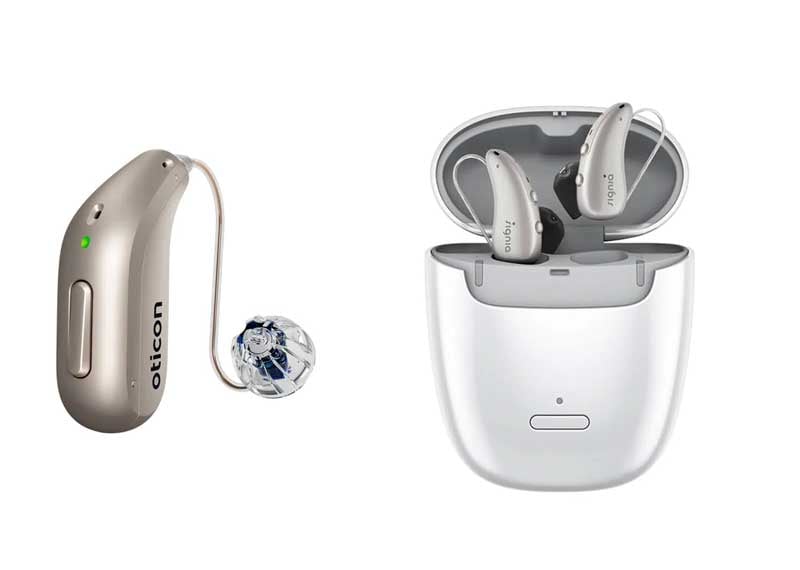
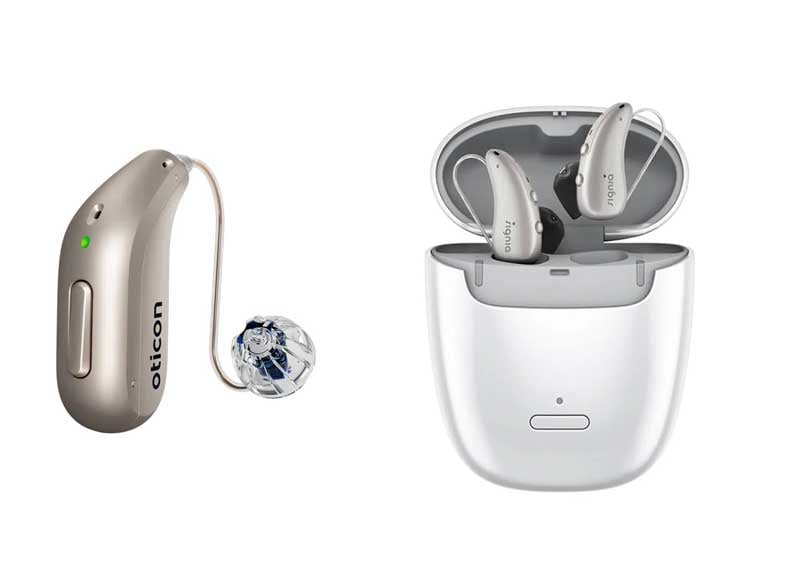
RIC aids have a small case that sits behind the ear—about the size of a kidney bean—connected to a thin wire that runs over the top of the ear and into the canal. The receiver (speaker) sits in the canal, either in a dome or a custom mould. They’re discreet, not invisible. If someone’s looking, they’ll see the wire and possibly the case behind your ear, but in everyday interactions—across a desk, at a café, in a meeting—most people won’t notice.
What you gain with a RIC is significant: rechargeable batteries (no more fumbling with size 10 cells), Bluetooth streaming, dual microphones with directional processing, more power for moderate-to-severe losses, and a much longer lifespan before the receiver needs replacing. In terms of real-world benefit, a well-fitted RIC will usually outperform an IIC, especially in background noise.
I’d estimate 70% of the devices we fit at The Audiology Place are RIC-style, not because patients don’t care about appearance, but because once they handle both options and hear the difference in a noisy environment, they choose function over absolute invisibility.
How We Figure Out What’s Realistic for Your Ears
When someone comes in asking about invisible hearing aids, here’s what we actually do.
First, a full diagnostic assessment: pure tone audiometry across 250 Hz to 8000 Hz, speech reception thresholds, word recognition scores, and tympanometry to check middle ear function. That tells us the degree and configuration of your hearing loss and whether you’re a candidate for a deep-fitting device from a power standpoint.
Then we look in your ears with an otoscope or video otoscope. I’m checking canal diameter, curvature, and whether there’s enough room for an IIC shell to sit comfortably past the second bend. If you’ve had ear infections, a perforation, or ear surgery, that may rule out certain styles.
If IIC or CIC looks feasible, we take an ear impression—a silicone mould that captures the exact shape of your canal. That goes to the manufacturer, who builds the shell. Turnaround is usually 7–10 business days.
At the fitting appointment, we programme the device using real-ear measurement (REM)—a probe microphone that sits in your ear canal and measures the actual sound pressure level at your eardrum. This ensures the hearing aid is delivering the gain prescribed by the fitting formula (usually NAL-NL2 or DSL) and not just what the software thinks it’s delivering. REM is non-negotiable for us; it’s the only way to verify a custom fit accurately.
We also run speech-in-noise testing (usually the BKB-SIN or QuickSIN) to see how well you’re understanding speech in realistic environments. If an IIC isn’t giving you enough directional benefit and your main complaint is difficulty at restaurants or family gatherings, we’ll have that conversation: a slightly larger device will likely serve you better.
Price, Rebates, and What You’ll Actually Pay
Custom IIC and CIC devices in Australia typically range from $3,200 to $4,500 per aid, depending on the technology level and manufacturer. RIC devices span a similar range—$2,800 to $4,800 per aid—but you’re getting more features for the same money.
If you’re eligible for the Hearing Services Program (pensioners, DVA gold card holders, some Centrelink recipients), you can access fully subsidised or top-up hearing aids. The devices available through the program tend to be RIC or BTE (behind-the-ear) styles; IIC options are limited and usually require a larger top-up payment.
Private health insurance with extras cover may provide a rebate—typically $500 to $1,000 per aid every few years, depending on your level of cover. Check your policy’s waiting periods and annual limits.
The Real Answer to “What’s the Most Invisible Hearing Aid?”
The most invisible hearing aid is the one you’ll actually wear. If an IIC makes you self-conscious about battery changes, or it doesn’t give you enough gain, or it whistles every time you chew, you’ll leave it in the drawer. I’ve seen it happen.
My advice: come in, let us assess your hearing and your ears, try a few styles, and make the decision based on what works—not just what’s smallest. Invisibility is one factor. It’s not the only one, and for most people, it’s not the most important one once they’ve lived with hearing aids for a few weeks.
At The Audiology Place, we’ll show you what’s realistic for your ears and your hearing loss, and we’ll fit whatever you choose using REM and proper verification. No sales targets, no pressure to upsell. Just transparent advice from clinicians who’ve done this a few thousand times.