
A sound arriving from one side reaches the far ear at most about 0.7 milliseconds after the near ear, and your brain can detect differences in arrival time as small as 10 to 20 microseconds (millionths of a second). It uses those differences, along with differences in loudness, to pinpoint where a sound is coming from. When one ear has untreated hearing loss, or when someone wears only one hearing aid despite having bilateral loss, that extraordinarily precise biological machinery stops working properly. For most people with hearing loss in both ears, two hearing aids work better than one. The real question is whether your particular hearing loss pattern makes bilateral fitting the right choice.
People often ask whether they can just try one hearing aid first. It’s a reasonable question, especially given the cost. But understanding how your auditory system locates sound shows why two aids are usually recommended when the loss is similar in both ears.
The Physics: Rayleigh’s Duplex Theory Still Holds
In 1907, Lord Rayleigh described what we now call the duplex theory of sound localisation: your brain uses two different cues depending on the frequency of the sound. For low frequencies, roughly below 1,500 Hz, your auditory system measures interaural time differences (ITD). Sound reaches the closer ear first. The maximum delay for an adult head is about 600 to 700 microseconds when the source is directly to one side.
For higher frequencies, physics gets in the way. Wavelengths become too short for your brain to reliably track timing differences, so instead it measures interaural level differences (ILD). Your head casts an acoustic shadow. A sound from your right will be louder in your right ear, sometimes by 10 to 20 dB at 4,000 Hz and above, because your head blocks high-frequency sound before it reaches the far ear.
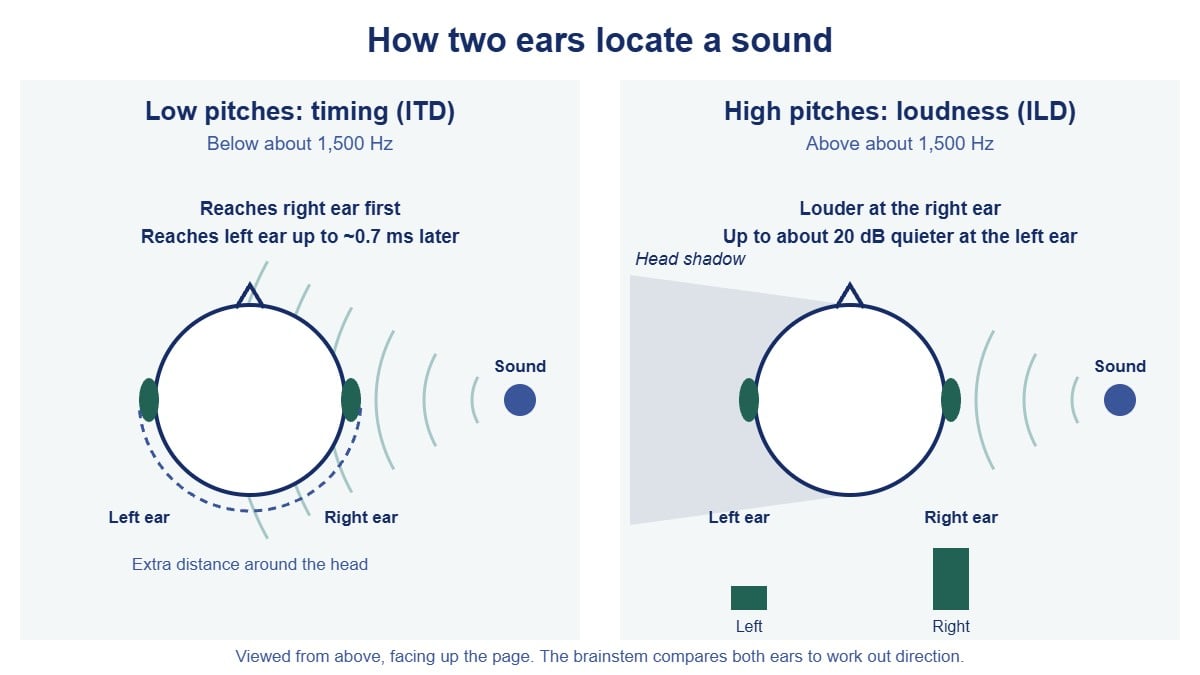
These aren’t backup systems. Your brain uses both simultaneously, cross-checking one against the other. The medial superior olive in your brainstem processes timing cues; the lateral superior olive handles level cues. These circuits develop early in life, and they work best when both ears deliver clear input.
The Three Binaural Advantages: Shadow, Squelch, and Summation
When audiologists talk about binaural hearing, we’re usually referring to three measurable benefits.
Head shadow is the simplest. If someone is speaking on your right and you have normal hearing in that ear, you get the full signal. Your left ear receives a version attenuated by your head, particularly in the high frequencies where consonants live. If your right ear has a 40 dB loss and you’re not wearing a device there, you’ve lost that advantage entirely. You’re now relying on the shadowed ear for a signal that was already degraded. People experience this as “I’m fine one-on-one, but I struggle when someone talks from my bad side.”
Binaural squelch is more sophisticated. When your brainstem receives input from both ears, it can compare the signals and suppress noise that’s out of phase or coming from a different location than the target speech. The benefit is modest, typically 2 to 3 dB in controlled conditions, but in a noisy restaurant even a few decibels of signal-to-noise ratio can make a noticeable difference to how much of a conversation you follow.
Binaural summation means that two ears hearing the same sound perceive it as louder than either ear alone. At threshold, the advantage is about 3 dB. It’s why people often report that bilateral hearing aids sound “clearer” even when we’ve matched gain precisely to each ear’s loss. You’re not imagining it; your brain genuinely integrates the input more effectively.
These advantages shrink or disappear when only one ear is fitted. There is also a longer-term concern: what happens to the unaided ear.
Auditory Deprivation: Use It or Lose It
In 1984, Silman and colleagues published work that changed how we think about unilateral fitting. They tracked word recognition scores in patients fit with one hearing aid despite having bilateral loss. Over time, sometimes just a few years, the unaided ear’s word recognition deteriorated significantly more than the aided ear, even though the pure-tone thresholds (the beeps you hear during a hearing test) stayed roughly the same.
This is late-onset auditory deprivation. Your auditory cortex is plastic, even in adulthood. When one ear stops sending useful input, the brain reallocates resources. The result can be an ear whose thresholds still match the other side but whose word recognition is noticeably poorer. Fitting the second ear can help, and some people recover part of the lost clarity, but recovery isn’t guaranteed.
The effect doesn’t happen to everyone, but it has been reported repeatedly and is largely preventable. Fit both ears from the start, and word recognition typically remains symmetrical or declines symmetrically with age and progression of loss.
When One Hearing Aid Actually Makes Sense
I’m not absolutist about this. There are legitimate reasons to fit one ear.
Asymmetric loss is the clearest case. If you have a moderate loss in one ear and profound loss with poor word recognition in the other, say, 20% on a word recognition test even at loud presentation levels, adding a device to the poor ear sometimes creates more distortion than clarity. We’ll trial it, because occasionally the binaural benefit outweighs the distortion, but if you consistently perform worse in noise with two devices than with one, the testing tells us what to do.
Dead ear or single-sided deafness is different again. You’re not a candidate for a traditional hearing aid on the non-functional side, but you might benefit from a CROS system (microphone on the bad side, signal transmitted to a device on the good side) or a bone-conduction implant. Those are separate conversations.
Financial constraints are real. I’d rather someone wear one well-fitted, properly programmed device than no device at all, or than two cheap amplifiers bought online with no verification. But if the only barrier is cost, it’s worth checking your private health insurance extras cover and whether you’re eligible for subsidised devices through the government Hearing Services Program before settling on one aid.
Wireless Ear-to-Ear Communication: Why It Matters
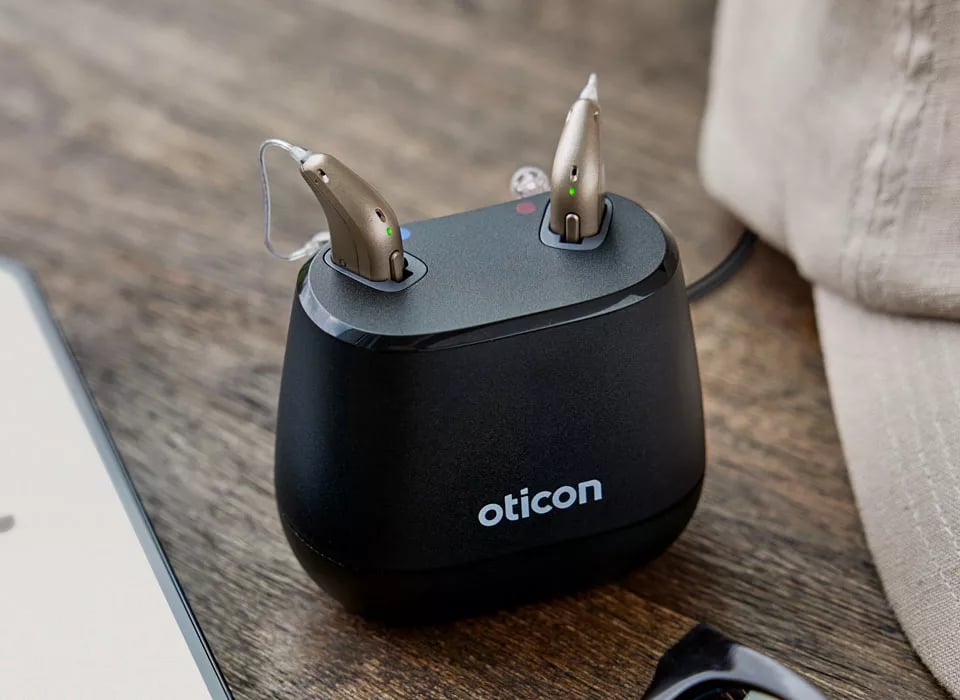
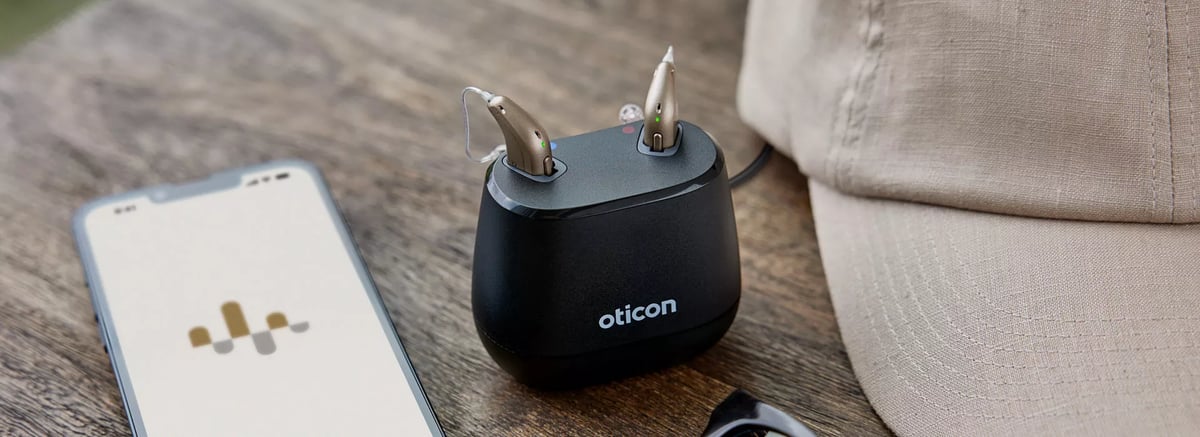
Modern hearing aids don’t just sit passively in your ears. Many current models talk to each other wirelessly. When you adjust volume on one side, the other side matches. More importantly, they share information about the sound environment.
If the left device detects speech in noise and switches to a directional microphone mode, the right device makes the same switch, and they coordinate the directionality to focus on the same source. If you’re streaming phone audio, both devices receive the signal, preserving binaural cues even for the phone call.
This is where matched latency becomes critical. If one device processed sound even a few milliseconds slower than the other, it would introduce an artificial interaural time difference far larger than any natural one. Your brainstem could read that as a location cue, pulling sounds to one side or making localisation harder. Hearing aid processing delays are usually a few milliseconds, and a matched pair from the same manufacturer is designed to keep the two sides in step.
Mixing brands, or pairing a much older aid with a new one, can lose the ear-to-ear link and may introduce mismatched delays. If a replacement aid on one side suddenly makes sound seem lopsided, that mismatch is worth checking before assuming you need a new prescription.
What This Means in Practice
If you have roughly symmetrical hearing loss in both ears, and most age-related and noise-induced losses are symmetrical, bilateral fitting isn’t upselling. It gives the binaural system the two inputs it relies on.
Most people localise better, understand speech in noise better and cope with noisy places for longer before fatigue sets in. Wearing two aids also helps protect word recognition in both ears over the long term.
We still check the result for each person. If your testing or your real-world experience genuinely shows no benefit from the second aid, we adjust the plan.
For most people with loss in both ears, the case for two hearing aids isn’t about volume. Locating sound depends on microsecond timing and small level differences between the ears, compared by brainstem circuits that need input from both sides to do their job.