
Our national survey of 425 Australians reveals a strange contradiction at the heart of hearing care: we believe in hearing aids, we trust the professionals who fit them, and we still won’t get one.
Based on original research from The Audiology Place Consumer Perception Survey 2026 (n=425)
Of 425 Australians who completed The Audiology Place Consumer Perception Survey 2026, 88.7% said they trust audiologists. In the same survey, 47.7% admitted to having done absolutely nothing about their hearing in the past 12 months. The two figures describe the same people.
That sums up the strangest finding in a year of survey work. Australians know who the experts are. Australians believe what the experts would tell them. Australians won’t actually go and see them.
The dataset is drawn from a national panel of 390 respondents, supplemented by 35 targeted respondents recruited separately. Ages ran from 18 to 89, every state and territory was represented, and the survey covered trust, barriers, behaviour, awareness, and stigma. The verbatims, presented exactly as respondents typed them, are where the contradictions become specific.
One man wrote: “Hope I don’t need them.”
A woman in her late forties: “Helpful but makes you feel old.”
Someone, committed to caps lock: “THEY ARE OK IF YOU NEED THEM BUT CAN BE EXPENSIVE.”
The most economical reply in the dataset was three words long: “A necessary evil.”
These respondents weren’t being asked to debate hearing aids. They were being asked what came to mind. The answers came back loaded with grudge.
audiology_place_hearing_aids_infographic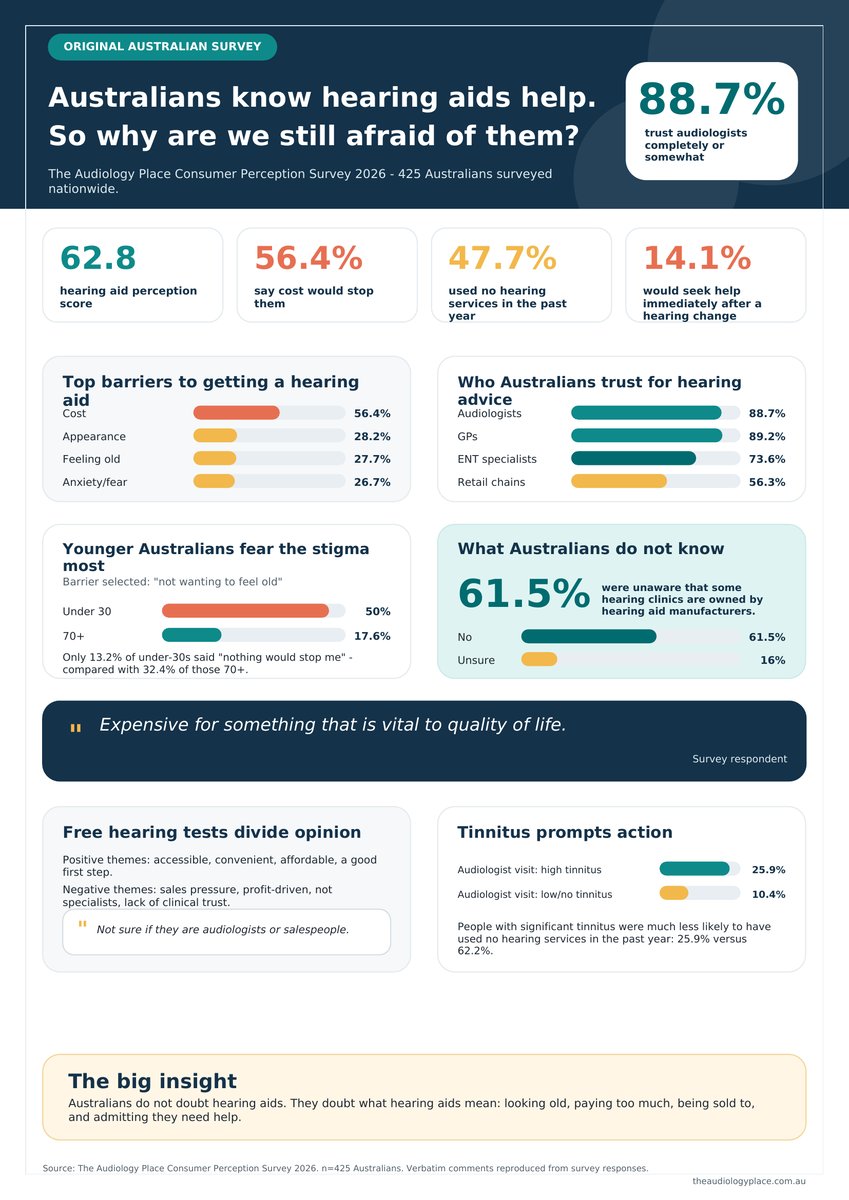
Trust
87.8% of respondents said they trust audiologists. GPs scored comparably, with combined trust at 89.2%. ENT specialists came in lower, at 73.7% combined trust. Family and friends sat below that, online search lower still, and AI chatbots at the bottom, with 23.4% of respondents saying they don’t trust them at all and only 2.1% trusting them completely.
The audience is willing to listen. They’ve identified the people they would believe.
Asked who they would actually visit first if they noticed a change in their hearing, 66.4% said their GP. Only 32.3% said an audiologist. Two-thirds of the sample would prefer to start with a generalist rather than the specialist they say they trust more.
Time to seek help breaks down like this. 14.1% would go immediately. 26.9% would wait a few days. 19.7% would wait a week. 15.9% would wait a month. 10.0% would wait several months. 12.1% would only mention it if it came up at a GP appointment they’d already booked for something else. And 1.3% would never mention it at all. For a sizeable chunk of the country, hearing loss doesn’t warrant its own conversation.
The inaction figure is worth reading twice. 47.7%. Almost half the sample had used no hearing-related services of any kind in the past 12 months. No audiologist, no hearing test, no GP discussion about hearing. In a country where roughly one in six adults has measurable hearing loss.
Tinnitus is the variable that moves these numbers. Among respondents without significant tinnitus, 62.2% had done nothing in the past year. Among those with significant tinnitus, the rate fell to 25.9%. Audiologist visits also more than doubled when tinnitus was present, from 10.4% to 25.9%. A constant ringing in the ears appears to be what it takes to provoke action.
On cost, and what cost means
When asked to name their top three barriers to getting a hearing aid, 56.4% of respondents cited cost. Appearance was second at 28.2%. Stigma around feeling old came in at 27.7%. Anxiety or fear about using them at 26.7%.
Australian hearing aids commonly run $3,000 to $5,000 per device, and most fittings involve a pair. For anyone outside the Hearing Services Program eligibility list (broadly pensioners, DVA cardholders, and a few other concession groups), the bill lands entirely in private hands. Private health insurance generally returns a small portion. Medicare does not contribute.
The numbers say cost is the leading barrier. The verbatims say cost is rarely just cost.
“Total overpriced rip-off.”
“Cheap products sold for massive profit.”
“They said I needed hearing aids for $5,000. I did not believe them.”
That last response is from a respondent who didn’t say they couldn’t afford the recommendation. They said they didn’t accept it. Whatever the clinician advised, the consumer took it as a sales pitch. That’s a separate problem from affordability, and it can’t be solved with a payment plan.
Perceptions of free hearing tests at large retail chains, such as Specsavers and similar models, are about as split as you’d expect. Average perception landed at 69.7 out of 100. Some respondents wrote things that read like testimonials.
“I feel very positive about Specsavers because they make essential healthcare like hearing tests and glasses feel straightforward, affordable, and completely pressure-free.”
Others did not.
“Come in, sucker.”
“I think they are trying to sell me something.”
“Feels like a sales funnel, not healthcare.”
“Not sure if they are audiologists or salespeople.”
“I sometimes would feel you would be told of a hearing issue to drum up more business.”
One respondent reported being told they needed hearing aids at a retail chain, then visiting an ENT specialist who told them they didn’t. The respondent concluded: “I believe that my ENT specialist saved me a lot of money.”
It is impossible to judge whether that original recommendation was correct or incorrect from a survey response. What’s worth noting is the framing the respondent reached for. The clinician had become an adversary to defend against, and the ENT was the rescue. Anyone trying to build trust in clinical hearing care has to reckon with that mental model already in place.
The young are more afraid than the old
The age data on stigma surprises most people I’ve shown it to. Among respondents under 30, 50% said not wanting to feel old would keep them from getting a hearing aid. Among the over-70s, 17.6%. The further away a respondent sits from actually needing a hearing aid, the more dread they bring to the idea.
Appearance runs in the same direction. 36.8% of under-30s named it a barrier. 18.9% of over-70s. Confidence runs in reverse. 13.2% of under-30s said nothing would stop them from getting a hearing aid if they needed one. 32.4% of over-70s said the same.
The under-30 verbatims have the unmistakable tone of a problem someone has decided to push fifty years into the future:
“Scary and for old people.”
“I wouldn’t want to have to wear one.”
“How I really didn’t want to have them.”
Older respondents wrote shorter, calmer replies:
“If I needed one, I’d get one.”
“Very advanced these days, would try if necessary.”
“Hearing assistance.”
One group breaks the pattern. Respondents who rated their own hearing as poor (below 50 out of 100 on the self-assessment) gave hearing aids a perception score of 55.7, lower than the 65.5 from respondents with good hearing. Appearance anxiety in the poor-hearing group climbed to 40%. Confidence dropped. Living with hearing loss does not make people feel better about the devices that treat it.
Women hesitate more
Gender split in the data is consistent and largely undiscussed. Women cite cost as a barrier at 61.5%, compared with 51.1% for men. Women report anxiety about hearing aids at 31.0%, against 22.1% of men. On most emotional barriers, women score higher.
The gaps are not enormous. They are also not noise. Why women feel more hesitant about hearing aids than men is a worthwhile question for someone with a research budget to answer, and so far nobody has.
78.4% of Australians don’t know who owns their clinic
61.5% of respondents did not know, before taking the survey, that some hearing clinics in Australia are owned by hearing aid manufacturers. Another 16.9% were unsure. 21.5% knew.
In some locations, more than 50% of the hearing clinics available are chain stores owned by manufacturers. It is an issue large enough that the ACCC has issued a warning about confusion.
Several of the largest hearing clinic chains operating in Australia are owned by the same companies that manufacture hearing aids. A clinician working in one of those clinics is being paid by an organisation whose commercial outcome depends on hearing aid sales. That clinician may give excellent advice. The arrangement still exists, and the consumer still deserves to know it exists.
Awareness by age shows the gap most clearly in the 31-to-50 range. 18-19% awareness across that decade and a half. The Australians making clinic choices in their peak working and parenting years are doing so without a piece of information that materially affects how they would weigh the advice they receive.
When respondents in the survey are told about manufacturer ownership later in the questionnaire, the suspicious language elsewhere in the dataset takes on a different shape. “Very mistrusting of the healthcare industry.” “Don’t think they have the expertise. Just selling what is on offer.” The structure was sitting there. Most respondents could feel it but were unable to name it.
A note on policy
Hearing care in Australia has three policy peculiarities that this survey indirectly touches on.
Audiology is not yet a registered profession under AHPRA, the Australian Health Practitioner Regulation Agency. Nurses, doctors, dentists, physiotherapists, psychologists, optometrists, even Chinese medicine practitioners are AHPRA-registered. Audiologists are not yet. Professional certification is handled by Audiology Australia and the Australian College of Audiology, both voluntary bodies. A consumer with a complaint against an audiologist has nowhere near the recourse available to a consumer with a complaint against an optometrist. AHPRA registration for audiology has been a topic of sector conversation for years. It has not happened.
The Hearing Services Program subsidises devices and services for pensioners, DVA cardholders, and certain concession holders. For working-age Australians who don’t hold a relevant card, hearing care falls largely outside Medicare. Private health insurance returns a small portion of the cost, the rest is private. Almost the entire age range where early intervention would pay the largest long-term dividend, roughly 40 to 65, is sitting outside meaningful public subsidy.
Choice in hearing care depends on disclosure that doesn’t really exist. There is no requirement for hearing aid clinics to disclose ownership relationships at the point of service. A consumer walking into a chain clinic generally has no way of knowing whether the brand of hearing aid they are about to be sold is owned by the parent company of the clinic they are sitting in. Sometimes the relationship is publicly known. Often it isn’t. Australian consumers buying a hearing aid have less mandatory disclosure available to them than Australian consumers buying a vacuum cleaner.
These three issues, regulation, funding, and disclosure, sit underneath the survey findings. They explain part of why a respondent can trust an audiologist and still distrust the system that the audiologist works inside. They also explain why a clinic’s independence in this market is a piece of consumer information rather than a marketing slogan.
Where does this leave the survey
The 425 Australians in this dataset will go on praising hearing aids and refusing to wear them. They will trust audiologists and visit their GP instead. They will think hearing aids look terrible until they need one, then they will think hearing aids look terrible while wearing one, then mostly they will get used to it.
Late in the file, an older respondent answered the question about free hearing tests with five words and no punctuation: “Trust process but unsure about costs.”
It’s possibly the best summary of the entire survey. The clinical pathway has earned credibility. The commercial pathway around it has not. The work of separating one from the other in the public mind hasn’t been done by the industry yet, and the consumers are quietly waiting.
Meanwhile, 47.7% of them are doing nothing at all.