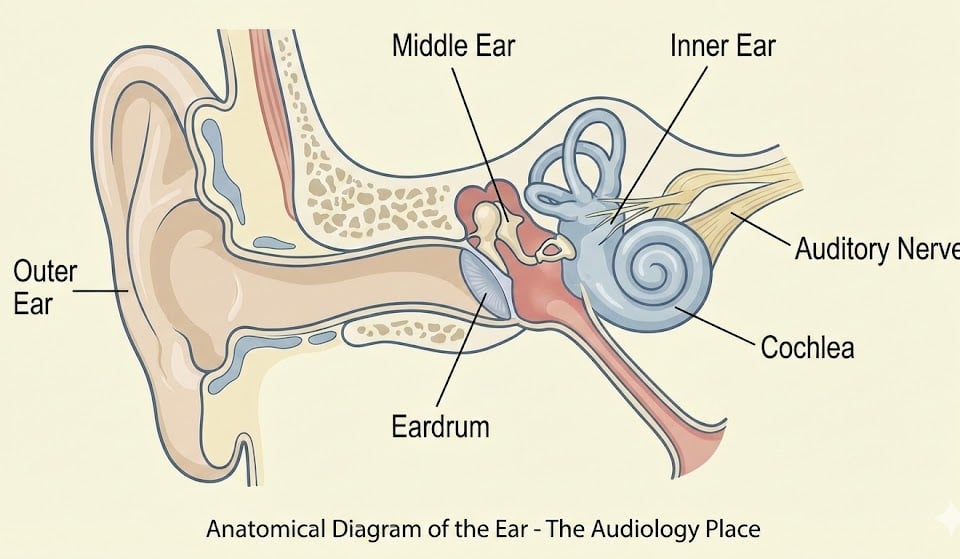
Otosclerosis is an abnormal bone growth in the middle ear that gradually fixes the stapes, the smallest bone in your body, preventing it from vibrating properly and transmitting sound to your inner ear. The result is a progressive conductive hearing loss that typically begins in your 20s to 40s, often affects both ears (though usually one worse than the other), and has a frustrating tendency to run in families. If you’ve noticed your hearing declining and you’re relatively young, with no history of noise exposure or ear infections, otosclerosis is one of the conditions your audiologist and ENT will be looking for.
The pattern is fairly consistent. People describe struggling to hear conversation in quiet environments, not just noisy restaurants, which everyone finds difficult, but actually missing what their partner says across the dinner table at home. Some notice they hear speech better in noisy environments than quiet ones (a phenomenon called paracusis of Willis), probably because people talk louder over noise while the conductive loss dampens the noise itself. Because the eardrum looks completely normal, the problem is easy to miss on a quick look in the ear: it’s hidden behind an intact tympanic membrane.
What Causes Otosclerosis?
The exact cause remains unclear despite decades of research, though we know it involves abnormal bone remodelling specifically in the otic capsule: the dense bone surrounding your inner ear. Normally, the stapes bone sits in the oval window and rocks back and forth, pistonlike, to transmit sound vibrations to the fluid in your cochlea. In otosclerosis, spongy bone grows around the stapes footplate, eventually cementing it in place.
Genetics plays a significant role: otosclerosis often runs in families, and having an affected parent raises your risk. The condition is more common in Caucasian populations and affects women roughly twice as often as men. Many women first notice hearing loss during or shortly after pregnancy, and hormonal changes are thought to play a part, although studies disagree on how strong the effect is.
Some research has investigated a possible measles virus connection, and there’s interesting data showing lower otosclerosis rates in populations with high measles vaccination coverage, but the link remains unproven. What we know with certainty is that if you have otosclerosis, you didn’t cause it through anything you did or didn’t do.
Otosclerosis Symptoms: What Patients Actually Notice
The hallmark symptom is progressive hearing loss, typically starting in one ear and eventually affecting both. But the subjective experience varies. Some patients describe a “fullness” in their ears, like they’re blocked but yawning doesn’t help. Others notice tinnitus, often a low-frequency roar rather than a high-pitched ring, that can be more bothersome than the hearing loss itself.
The hearing loss is characteristically conductive, meaning the problem is in sound transmission through the middle ear, not in the cochlea (inner ear) itself. This is why patients often report they can hear themselves chewing incredibly loudly, or their own voice sounds odd when they speak. It’s also why many people with early otosclerosis unconsciously speak more softly: they’re hearing their own voice through bone conduction, which bypasses the stapes entirely, so they don’t realise they’re becoming harder to hear.
As otosclerosis progresses, some patients develop a mixed hearing loss: conductive loss from the fixed stapes plus a sensorineural component from otosclerotic changes affecting the cochlea itself. This complicates treatment and makes early diagnosis more important.
How Otosclerosis is Diagnosed
Diagnosis requires pure tone audiometry, tympanometry, and ideally acoustic reflex testing: all standard components of a comprehensive hearing assessment. The audiometric pattern is quite characteristic: a conductive hearing loss (where bone conduction thresholds are normal or near-normal, but air conduction thresholds are elevated), often with a distinctive notch at 2000 Hz on bone conduction testing called Carhart’s notch. This isn’t a true sensorineural loss but an artefact of stapes fixation affecting bone conduction measurement.
Tympanometry usually shows normal middle ear pressure, with normal or slightly reduced eardrum mobility, while acoustic reflexes are typically absent: the stapedius muscle still contracts, but the fixed stapes can’t move enough to register a change. A young adult with a conductive loss, normal-looking eardrums, a normal tympanogram and absent reflexes is a classic pattern that puts otosclerosis high on the list.
At The Audiology Place, our role is diagnostic and referral. Once we’ve identified an audiometric pattern consistent with otosclerosis, we send our findings to your GP so you can be referred to an ENT surgeon with experience in ear surgery (an otologist). The ENT will examine the ear microscopically and may order high-resolution CT imaging of the temporal bone to confirm the diagnosis and assess the extent of disease, though imaging isn’t always necessary if the clinical and audiometric picture is clear.
Otosclerosis Treatment: Surgery vs Hearing Aids
This is where the conversation gets interesting, and where patients need genuinely independent advice. The gold-standard treatment for otosclerosis is stapedectomy (or the newer stapedotomy), a microsurgical procedure where the surgeon removes all or part of the fixed stapes and replaces it with a prosthesis, usually a tiny piston made of titanium or Teflon. Success rates in experienced hands are high: published studies commonly report closure of the air-bone gap to within 10 dB in around 90% of cases, which largely restores the conductive part of the hearing loss.
Outcomes can be life-changing. Once the ear has healed, many patients find their hearing is better than it has been in years.
But stapedectomy isn’t risk-free. There’s a small risk (commonly quoted at around 1%) of severe or total sensorineural hearing loss in the operated ear, a fairly common and usually temporary taste disturbance (because the chorda tympani nerve runs through the middle ear), and a small risk of persistent vertigo or facial nerve injury. Long-term, there’s a chance of prosthesis displacement or re-fixation requiring revision surgery. Outcomes are generally better with surgeons who perform the procedure regularly, so it’s reasonable to ask your surgeon how often they do it.
Hearing aids are the conservative alternative. Modern hearing aids usually manage conductive hearing loss well because the cochlea is often healthy: you mainly need more volume and some adjustment to frequency response. The audiometric pattern in otosclerosis is actually quite straightforward to fit. We’re typically looking at mild to moderate low-frequency conductive loss, and even entry-level receiver-in-canal (RIC) hearing aids often work well.
The decision between surgery and hearing aids is deeply personal. Some patients are uncomfortable with the surgical risks, even small ones, when hearing aids provide good functional hearing. Others find hearing aids psychologically difficult: they’re young, they feel too young to wear hearing aids, they have young children and worry about devices getting grabbed or lost, or they simply want to fix the underlying problem rather than manage it. Both are completely valid positions.
Making the Treatment Decision
Surgery tends to suit people with:
- A substantial conductive component (air-bone gap) that is affecting their quality of life
- Bilateral disease where aids would be needed for both ears long-term
- Active lifestyles where hearing aids feel limiting
- Realistic expectations about surgical risks and recovery
Patients who often prefer hearing aids:
- Have only-hearing-ear or pre-existing sensorineural loss in the opposite ear (where surgical risk feels unacceptable)
- Have medical conditions increasing surgical risk
- Are uncertain about the decision and want a trial period
- Have very mild loss that’s not yet significantly impacting function
There’s no wrong answer. Some younger adults with loss in both ears decline surgery and are content with hearing aids; some older adults with loss in one ear choose surgery and do very well. The key is making an informed decision with accurate information about both options.
What to Expect at The Audiology Place
If you’re experiencing progressive hearing loss and otosclerosis is suspected, a comprehensive diagnostic assessment takes about 90 minutes. We’ll complete pure tone audiometry across the full frequency range, speech audiometry in quiet and in noise, tympanometry, and acoustic reflex testing. If the pattern suggests otosclerosis, we’ll discuss the findings, provide referral to appropriate ENT surgeons with specific otosclerosis expertise, and help you understand what questions to ask at that appointment.
If you proceed with surgery, we can repeat your hearing test once the ear has healed, at the time your surgeon recommends, to confirm the result. If you choose hearing aids, we’ll provide accurate verification using real-ear measurement to ensure appropriate amplification across frequencies, which is especially important in conductive losses where prescription targets differ from standard sensorineural fittings.
We don’t sell hearing aids to surgical candidates to make a quick sale when they’d be better served by referral. We also don’t push surgery on patients who’d be perfectly well-managed with hearing aids. Our job is accurate diagnosis, appropriate referral, and helping you make an informed decision based on your individual circumstances and priorities.