
The extraordinary underwater world of sound, fish ears, baby coral and reefs that call new life home
When we think of a healthy coral reef, we tend to picture brilliant corals, enormous schools of brightly coloured fish, turtles gliding overhead, and tiny creatures disappearing into impossibly complicated structures. Yet a healthy coral reef has another characteristic that is much less obvious. It is noisy.
In Ocean (which I have just finished reading – highly recommend!), David Attenborough describes what happens when you put your head underwater above a coral reef. Instead of silence, you may hear an almost continuous crackling sound, rather like rain falling on a tin roof. To human ears, it can initially sound like static. In reality, it is the combined sound of an entire biological community. Snapping shrimp contribute much of the characteristic crackling. Fish add grunts, knocks, croaks, pulses and other calls. Animals feed, move, defend territories and communicate with one another. Waves, currents and the physical reef itself contribute additional sounds. Together, these create what scientists call a soundscape: the acoustic character of an environment.
What is particularly fascinating is that the animals living on and around the reef are not simply producing this soundtrack. Many of them appear to be using it as information. For some, the sound of the reef may help answer one of the most important questions of their lives: where should I live?
One of the reef’s loudest animals is remarkably small
Some of the loudest contributors to a coral reef soundscape are snapping shrimp. Their famous “snap” is not simply the sound of one side of a claw striking the other. Snapping shrimp have one greatly enlarged claw that can close extraordinarily rapidly. The movement fires out a jet of water, producing a tiny cavitation bubble. When that bubble collapses, it creates a very brief but intense acoustic pulse. One shrimp does not make a reef soundscape, of course, but large numbers of snapping shrimp firing their claws produce the persistent crackling so often associated with tropical marine environments. Among that crackling are the sounds of fish. Different species make an extraordinary variety of sounds, including grunts, croaks, pops, knocks and pulses, associated with behaviours such as courtship, aggression, territorial defence and social interaction. The reef is therefore not producing a single sound. It is an acoustic community, with different species contributing different components.
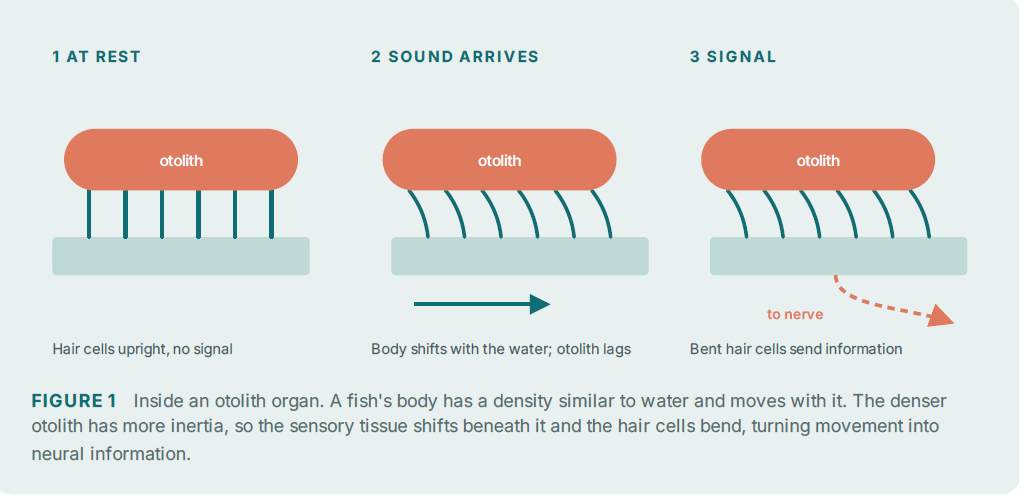
Inside an Otolith
Fish have ears – just not ears like ours
For an Audiologist, perhaps the most irresistible part of this story is the anatomy. Fish do not have visible pinnae (the big part us humans have decorating the outside of our heads), but that certainly does not mean they cannot hear. Bony fish possess an inner ear containing sensory hair cells and dense calcium carbonate structures called otoliths. The word comes from the Greek roots for “ear” and “stone”: quite literally, an ear stone.
A typical bony fish has three paired otolithic organs in the inner ear: the saccule, utricle and lagena. These structures are involved in hearing, balance and the detection of movement. Their operation depends on an elegant piece of physics. Because the body of a fish has a density relatively similar to the surrounding water, it moves with underwater acoustic particle motion. The much denser otolith has greater inertia and does not move in precisely the same way. The resulting movement between the otolith and the surrounding sensory tissue bends sensory hair cells, converting mechanical movement into neural information.
There is a pleasing parallel with our own anatomy. Humans also possess a utricle and saccule in the vestibular system, although ours contain tiny calcium carbonate crystals called otoconia rather than the large otoliths found in many fish. The anatomy and function are not identical, but the underlying concept is strikingly familiar: mechanical movement acts on dense structures, sensory hair cells are deflected, and information about motion is passed to the nervous system.
Fish otoliths are also useful for something completely different. Like the rings of a tree, they can lay down growth increments. Scientists can examine otoliths to estimate a fish’s age and, in some cases, reconstruct aspects of where it has lived and the environmental conditions it has experienced. An organ involved in hearing and balance can therefore also become a biological record of the animal’s life. I find this so unbelievably fascinating!
Not all fish hear in the same way
Underwater hearing is more complicated than simply measuring sound pressure. Sound travelling through water involves both pressure changes and particle motion, and different fish species are sensitive to these components in different ways. Fish inner ears are fundamentally sensitive to particle motion. However, some fish have evolved additional anatomical mechanisms that allow them to detect sound pressure more effectively. The most important of these involves the swim bladder, a gas-filled organ primarily associated with buoyancy. Gas is much more compressible than the surrounding tissue and water. When a sound-pressure wave passes through a fish, the swim bladder can expand and contract slightly. In species where the swim bladder is positioned close to the inner ear, or mechanically linked to it, those movements can be transmitted to the auditory system. Some species therefore hear a wider range of frequencies, or detect much quieter sounds, than others. There are even groups of fish with highly specialised structures connecting the swim bladder to the ear. In some species, small bones known as Weberian ossicles form a mechanical chain between the swim bladder and the inner ear, rather like an underwater biological sound-transmission system.
So there is no single “fish audiogram”. Fish hearing varies enormously according to species, anatomy and ecology.
Baby fish are not simply drifting helplessly through the ocean
This anatomy becomes even more remarkable when we consider the life cycle of reef fish. Many coral reef fish begin their lives not on the reef, but in the open ocean. Eggs hatch into larvae that become part of the plankton and may be carried considerable distances by currents. Eventually, however, those young fish need to find suitable habitat and settle. It was once tempting to imagine them as tiny passive passengers, carried around until they happened to bump into a reef. Research has shown that this is not the case. Late-stage reef fish larvae can be capable swimmers. They possess developing visual, olfactory, lateral-line and auditory systems, and they can make active behavioural choices. In some reef fish, the major sensory organs are already present at hatching. As the larvae develop, the inner ears and otoliths become larger and more sophisticated, while swimming ability improves dramatically.
This creates a fascinating navigational problem. Imagine being a tiny animal, only millimetres long, surrounded by an enormous ocean. Somewhere beyond the distance you can see is a coral reef where you might survive. How do you find it? Vision becomes useful when you are relatively close. Chemical cues may also provide information about suitable habitat. But sound travels very efficiently through water and can potentially carry information much farther than light in many marine environments. A healthy reef, in effect, broadcasts its existence.
Coral Reef Species
A reef can act like an acoustic beacon
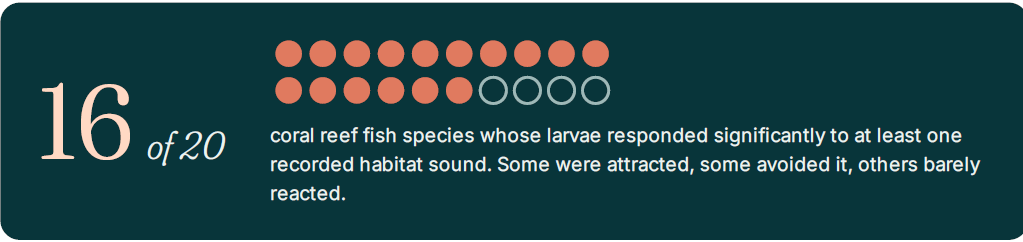
Researchers have spent decades investigating whether young fish and crustaceans use reef sound as a navigational cue. A substantial body of evidence now suggests that many do. Larvae from different species have been placed in experimental systems and given a choice between different recorded habitat sounds. Many show clear preferences. Importantly, they do not all choose the same thing. Some species are attracted to sounds characteristic of particular reef environments, while others appear to avoid sounds associated with unsuitable habitats. In one study involving larvae from 20 coral reef fish species, 16 responded significantly to at least one recorded habitat sound. Some were attracted to particular reef types, some showed avoidance, and others responded little or not at all. This suggests something more sophisticated than simply “noise means reef”. Young fish may potentially use the acoustic character of an environment to distinguish between different kinds of habitat. The soundscape may be telling them not only that there is a reef nearby, but something about the reef they are approaching.
A damaged reef may sound damaged
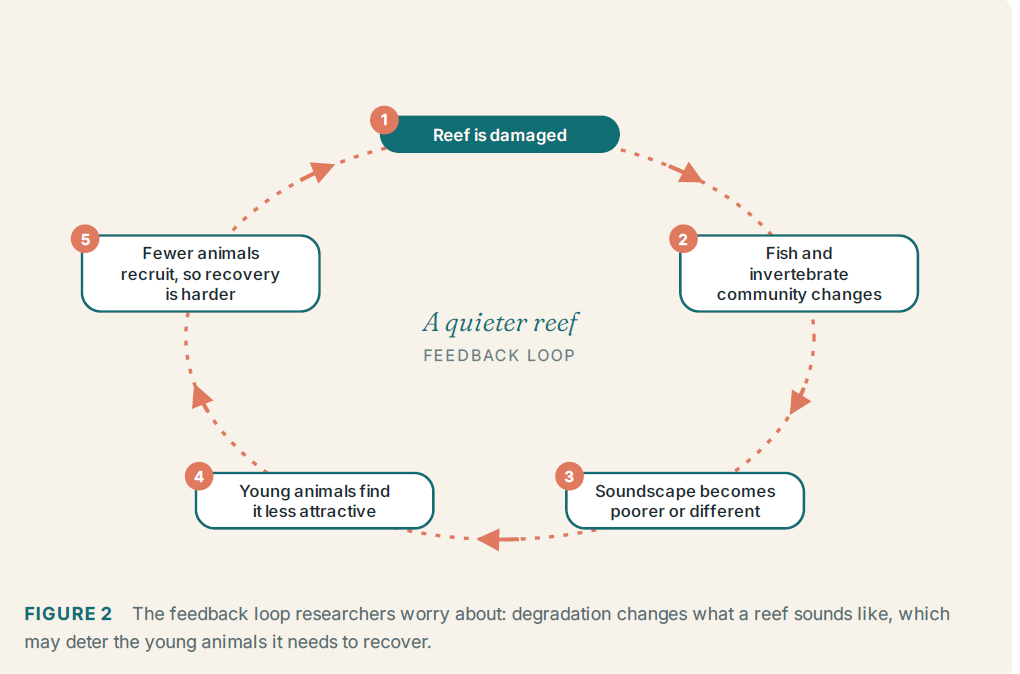
Unfortunately, this also means that when a coral reef deteriorates, the damage is not only visual. Coral bleaching, severe storms, pollution, overfishing and habitat destruction can alter the community of animals living on a reef. Different numbers and species of fish and invertebrates mean different biological sounds. The reef’s acoustic character changes along with its ecology. Research comparing healthy and degraded reefs has shown that young fish can respond differently to their recordings. In some experiments, sounds from degraded reefs have attracted fewer fish than sounds from healthier reefs. This introduces the possibility of a troubling ecological feedback loop. A reef becomes damaged. Its fish and invertebrate community changes. Its soundscape becomes poorer or different. Young animals searching for somewhere to settle find it less attractive. Fewer animals recruit to the reef, including animals that would normally graze algae, recycle nutrients or perform other ecological jobs. Recovery may then become even more difficult.
A degraded reef may therefore lose not only the organisms already living there, but part of the sensory advertisement that helps attract new life. That discovery led researchers to ask a wonderfully unusual question: if a damaged reef no longer sounds healthy, what happens if we make it sound healthy again?
A damaged Reef
Scientists put loudspeakers on damaged reefs
Researchers working on Australia’s Great Barrier Reef placed underwater loudspeakers on degraded reef patches and played recordings taken from healthy reefs. The technique is known as acoustic enrichment. During a field experiment lasting approximately 40 days, degraded reefs broadcasting healthy reef sounds attracted substantially more juvenile fish than control reefs without the added sound. Recruitment increased across different groups of fish, and the acoustically enriched reefs developed a more diverse fish community. This did not mean that researchers had discovered a magical cure for coral reef degradation. A speaker cannot reverse ocean warming, pollution or coral bleaching, and attracting fish to an unsuitable habitat would clearly be of little value if the underlying ecological problems were not addressed. But the experiment demonstrated something profound: changing what an ecosystem sounds like can influence which animals choose to enter it.
Sound is not merely a consequence of ecology. It can help shape ecology.
Then scientists discovered that coral itself may be listening
Fish have inner ears, sensory hair cells and nervous systems, so their response to sound is perhaps understandable. Coral is another matter entirely. Corals have no ears. They have no cochlea, no auditory nerve and no brain. Yet the early life stage of a coral is a tiny, free-swimming larva called a planula, and these larvae also need to find somewhere suitable to settle. Experiments have shown that coral larvae can respond to reef sound. In one striking study, researchers found that coral larvae moved towards underwater recordings of reef noise. Some of the animals involved were less than one millimetre long.
The word “hearing” needs to be used carefully here. Coral larvae are certainly not hearing in the human sense. Researchers believe they may detect mechanical vibrations or acoustic particle motion, possibly through sensory structures associated with the tiny cilia covering their bodies. The precise biological mechanism remains an area of continuing research. Nevertheless, the important point is remarkable: a creature with no recognisable auditory system can still detect information contained in an acoustic environment and alter its behaviour in response.
Healthy reef sounds may even encourage baby coral to settle
More recently, researchers have investigated whether acoustic enrichment might influence not only fish recruitment but coral settlement itself. In a field experiment reported in 2024, scientists used an underwater sound system to broadcast healthy reef sounds onto degraded reef habitat and measured settlement of coral larvae. Coral settlement was, on average, approximately 1.7 times higher at acoustically enriched sites than at controls, with even larger differences under some experimental conditions. The effect became weaker with increasing distance from the loudspeaker, but enhanced settlement was still detected tens of metres away.
Again, nobody is proposing that underwater speakers alone can restore the world’s coral reefs. The larger environmental causes of reef degradation remain the critical problem. But the research suggests that acoustic conditions may be one component of successful restoration. Conservation may need to consider not only what an ecosystem looks like, but what it sounds like.
Coral reefs even have something resembling a dawn chorus
There is another lovely parallel between coral reefs and terrestrial ecosystems. Bird-filled forests have a familiar dawn chorus. Reefs can have acoustic choruses too. Different fish species call more actively at particular times of day. Some increase acoustic activity around dawn or dusk, while snapping shrimp provide their almost continuous crackling background. The overall soundscape therefore changes over the course of a day and night. Researchers analysing long underwater recordings can detect these temporal patterns. A hydrophone left on a reef can capture the rhythms of an ecosystem even when no scientist is physically present. This has led to the rapid development of passive acoustic monitoring: essentially, giving the reef a very long-term microphone.
Scientists can leave underwater recorders in place and collect hours, days, months or even years of sound. Those recordings can then be analysed for changes in biological activity, species behaviour and habitat condition. It sounds almost like giving a coral reef an acoustic health check. There is, however, an important caution. A louder reef is not necessarily a healthier reef. Snapping shrimp can dominate particular frequency ranges, boat noise can dramatically alter recordings, storms and waves contribute non-biological sound, and different healthy habitats naturally sound very different from one another. Simple measures of “acoustic complexity” do not always correspond neatly with biodiversity or ecological health. In other words, putting a hydrophone underwater and measuring lots of sound is not enough. Scientists must understand who or what is producing the sound and what it means biologically.
For an Audiologist, there is something strangely familiar about that idea. Measuring sound is not the same as understanding hearing.
A world of information that we cannot see
Perhaps that is the most wonderful part of this story. Humans are enormously visual creatures. We look at a coral reef and immediately notice its colour, shape and movement. Yet another animal may be receiving an entirely different stream of information from exactly the same environment. A tiny fish travelling through the ocean may detect the particle motion produced by a reef. It may hear fish calling and snapping shrimp crackling. It may distinguish the acoustic character of one habitat from another. It may use those cues alongside smell, vision and other senses to make a decision that determines whether it survives. Even a coral larva, smaller than a millimetre and lacking anything we would recognise as an ear, appears capable of responding to the mechanical information contained within reef sound. A healthy coral reef therefore does not simply contain life. In a sense, it advertises life.
Every snap, grunt, croak, knock and pulse becomes part of an acoustic landscape that other organisms can use to understand their world. David Attenborough’s description in Ocean begins with the simple observation that putting your head beneath the water over a healthy coral reef reveals an extraordinary crackling noise. The deeper science makes that observation even more remarkable. To us, it may sound like static. To an animal somewhere out in the ocean, it may contain a very different message: There is life here. Come this way.
There is something wonderfully nerdy about finding the connections between the things you love. Hearing, science, the ocean and David Attenborough in one article? I was never going to resist. And now that I’ve started… birds and hearing are coming next.
The science behind the story
Montgomery, J. C., Jeffs, A., Simpson, S. D., Meekan, M., & Tindle, C. (2006). Sound as an orientation cue for the pelagic larvae of reef fishes and decapod crustaceans. Advances in Marine Biology, 51, 143–196. https://doi.org/10.1016/S0065-2881(06)51003-X
Vermeij, M. J. A., Marhaver, K. L., Huijbers, C. M., Nagelkerken, I., & Simpson, S. D. (2010). Coral larvae move toward reef sounds. PLoS ONE, 5(5), e10660. https://doi.org/10.1371/journal.pone.0010660
Lecchini, D., Bertucci, F., Gache, C., Khalife, A., Besson, M., Roux, N., et al. (2015). The influence of various reef sounds on coral-fish larvae behaviour. Journal of Fish Biology, 86, 1507–1518.
Gordon, T. A. C., Radford, A. N., Davidson, I. K., Barnes, K., McCloskey, K., Nedelec, S. L., Meekan, M. G., McCormick, M. I., & Simpson, S. D. (2019). Acoustic enrichment can enhance fish community development on degraded coral reef habitat. Nature Communications, 10, 5414.
Dimoff, S. A., Halliday, W. D., Pine, M. K., Tietjen, K. L., Juanes, F., & Baum, J. K. (2021). The utility of different acoustic indicators to describe biological sounds of a coral reef soundscape. Ecological Indicators, 124, 107435.
Montgomery, J. C. (2023). Fish bioacoustics: Navigating underwater sound. The Journal of the Acoustical Society of America, 153(5), 3048.
Soundscape enrichment increases larval settlement rates for the brooding coral Porites astreoides. (2024). Field research examining the effect of healthy reef acoustic enrichment on coral settlement.
Further reading
Attenborough, D. (2025). Ocean: Earth’s last wilderness.