If you’ve ever lain awake at night, acutely aware of a persistent ringing, buzzing, or hissing in your ears that seemed barely noticeable during the day, you’re not alone. Many tinnitus sufferers report that their symptoms become significantly more intrusive when they’re trying to sleep. This frustrating phenomenon is one of the most common complaints audiologists hear from patients, and understanding why it happens is the first step toward finding relief.
The experience of tinnitus worsening at night isn’t simply psychological, though our mental state certainly plays a role. There are legitimate neurological and environmental factors that make tinnitus perception more pronounced when we’re lying in the dark, trying to drift off to sleep. Let’s explore the science behind why tinnitus keeps so many people awake, and more importantly, what evidence-based strategies can help you reclaim restful nights.
The Neuroscience of Nighttime Tinnitus Perception
To understand why your ringing ears at night seem so much louder, we need to examine how the brain processes sound, particularly the phantom sounds of tinnitus.
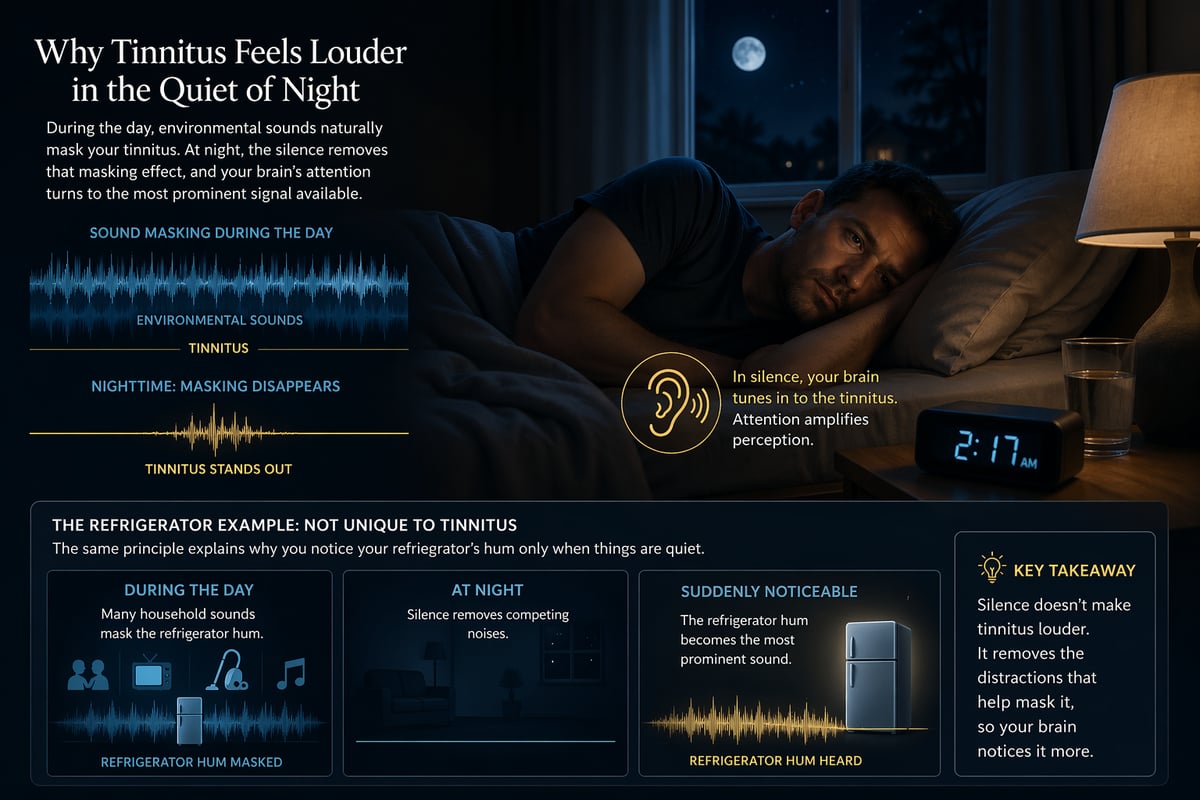
During waking hours, your auditory system is constantly processing genuine environmental sounds: conversations, traffic, keyboard clicks, television, music, and countless ambient noises that form the acoustic backdrop of daily life. These real sounds effectively “mask” the internal neural activity that generates tinnitus. Research published in *Hearing Research* has demonstrated that tinnitus likely arises from aberrant neural activity in the auditory pathway, particularly when the brain attempts to compensate for reduced auditory input due to hearing loss or cochlear damage.
When nighttime arrives and your environment becomes quieter, this natural masking effect disappears. The contrast between the silence and your tinnitus becomes stark. Without competing environmental sounds, the brain’s attention naturally focuses on the most prominent signal available—which is often the tinnitus itself. This phenomenon isn’t unique to tinnitus; it’s the same reason you might suddenly notice the hum of your refrigerator when other household noises cease.
Furthermore, the brain’s attentional networks operate differently at night. As we prepare for sleep, the prefrontal cortex, responsible for executive function and the conscious regulation of attention, begins to quiet. This reduced cognitive control means you have less capacity to deliberately direct your attention away from the tinnitus signal. The British Tinnitus Association notes in their clinical guidelines that this attentional shift is one of the primary reasons tinnitus becomes more intrusive during the pre-sleep period.
The Role of Fatigue and Stress in Tinnitus Perception
Beyond the acoustic environment, physiological factors significantly influence how we perceive tinnitus at night. Mental and physical fatigue can paradoxically heighten tinnitus perception, even though you might expect tiredness to dull your senses.
After a full day of activity, your brain’s filtering and habituating mechanisms become less efficient. Throughout the day, your brain works to categorise tinnitus as an unimportant signal that can be safely ignored—a process called habituation. However, when you’re exhausted, this filtering capacity diminishes. Neural fatigue means your brain is less able to suppress or “gate” the tinnitus signal, making it more noticeable.
Stress hormones also follow a circadian pattern that can affect tinnitus. Cortisol, the body’s primary stress hormone, typically peaks in the early morning and gradually declines throughout the day, reaching its lowest point at night. However, in individuals experiencing chronic stress or anxiety—conditions commonly associated with bothersome tinnitus, this pattern can become disrupted. Research in *Frontiers in Neurology* has shown that dysregulated stress responses can amplify tinnitus perception and create a self-perpetuating cycle: tinnitus causes stress, which in turn makes tinnitus more noticeable, particularly during quiet periods when worries tend to surface.
For many patients I’ve worked with in clinical practice, anxiety about sleep itself becomes a significant factor. If you’ve experienced several nights of tinnitus keeping you awake, you may develop anticipatory anxiety about bedtime. This psychological component activates the sympathetic nervous system, increasing arousal when you should be winding down, precisely the opposite of what you need for sleep. The tinnitus hasn’t necessarily become objectively “louder,” but your emotional response to it amplifies your perception of it.
The Connection Between Tinnitus and Underlying Hearing Loss
An often-overlooked factor in nighttime tinnitus is the relationship between tinnitus and hearing loss. Contemporary research indicates that approximately 80-90% of tinnitus cases occur alongside some degree of hearing impairment, even if it’s subtle and undiagnosed.
During the day, people with mild hearing loss often unconsciously compensate by lip-reading, using contextual clues, and benefiting from the visual information that accompanies communication. These compensatory mechanisms help mask both the hearing loss and the tinnitus. At night, lying in darkness with eyes closed, these visual aids disappear. Moreover, if you’ve been wearing hearing aids during the day, removing them at night eliminates both the amplification of environmental sounds that naturally mask tinnitus and the therapeutic effect that hearing aids can have on tinnitus perception.
The auditory cortex responds to reduced input from the cochlea (the hearing organ) by increasing its gain, essentially turning up its internal volume to “hear” missing frequencies. This neural compensation is thought to be a primary mechanism underlying tinnitus generation. When you remove hearing aids at night or enter a very quiet environment, this increased neural gain makes the tinnitus signal more prominent.
Evidence-Based Strategies for Managing Tinnitus at Night
Understanding the mechanisms behind nighttime tinnitus naturally leads us to practical management strategies. The following approaches are supported by clinical evidence and align with recommendations from organisations such as the British Tinnitus Association and the American Academy of Audiology.
Sound Enrichment: Your First Line of Defence
The most effective immediate strategy for managing tinnitus at night is sound enrichment—introducing gentle, neutral sounds into your bedroom environment to reduce the contrast between silence and your tinnitus. This isn’t about “drowning out” the tinnitus with loud noise, which can be counterproductive and disrupt sleep. Instead, aim for soft background sound at a level where you can still hear your tinnitus, but it’s less prominent.
Effective sound enrichment options include:
- Bedside sound machines: Devices that produce nature sounds, white noise, pink noise, or brown noise
- Sound pillows: Specialised pillows with built-in flat speakers that deliver sound without disturbing a bed partner
- Bedroom fans: Simple and effective for providing consistent ambient noise
- Smartphone apps: Numerous tinnitus-specific applications offer customisable soundscapes (ensure your phone is on “do not disturb” to avoid disruptive notifications)
- Purpose-designed tinnitus sound generators: Available through audiologists, these devices produce precisely calibrated sound therapy
From clinical experience, I’ve found that the most successful patients are those who experiment with different sounds and volumes to find what works specifically for them. What soothes one person may irritate another—pink noise, nature sounds, gentle music, or mechanical sounds all have their advocates.
Sleep Hygiene and Environmental Optimisation
Addressing tinnitus at night requires attention to overall sleep hygiene, as poor sleep practices can exacerbate tinnitus perception. Consider implementing these evidence-based sleep strategies:
Maintain a consistent sleep schedule: go to bed and wake up at the same time every day, even on weekends. This regularity helps regulate your circadian rhythm and makes it easier for your brain to transition into sleep mode despite the presence of tinnitus.
Create a wind-down routine that begins 30-60 minutes before bed. This might include dimming lights, engaging in relaxation techniques such as progressive muscle relaxation or gentle stretching, and avoiding stimulating activities or screens. The blue light from devices can suppress melatonin production, making sleep more elusive and leaving you more vulnerable to tinnitus-related distress.
Optimise your bedroom environment by keeping it cool (around 18°C is ideal for most people), dark, and dedicated solely to sleep and intimacy. If you’ve been lying awake for more than 20 minutes, get up and do a quiet, non-stimulating activity in dim light until you feel sleepy. This prevents your brain from associating your bed with wakefulness and tinnitus frustration.
Addressing the Underlying Factors
Managing nighttime tinnitus effectively often requires addressing the broader context of your hearing health and overall well-being.
If you haven’t had a comprehensive hearing assessment recently, this should be a priority. A thorough audiological evaluation—including pure tone audiometry, speech discrimination testing, tympanometry, and potentially otoacoustic emissions testing—can identify hearing loss that may be contributing to your tinnitus. For many patients, appropriately fitted hearing aids not only improve communication but also significantly reduce tinnitus perception, both during the day and night.
Tinnitus retraining therapy (TRT) and cognitive behavioural therapy for tinnitus (CBT-T) are evidence-based psychological approaches that can fundamentally change your relationship with tinnitus. These structured interventions address the attentional and emotional responses to tinnitus, reducing the distress it causes. Research published in *The Lancet* has demonstrated that CBT-T can significantly improve sleep quality and reduce tinnitus-related suffering.
Stress management deserves particular attention, given the bidirectional relationship between stress and tinnitus. Mindfulness meditation, yoga, regular physical exercise, and professional counselling can all help regulate your stress response. For some individuals, working with a psychologist who specialises in tinnitus management can provide valuable coping strategies tailored to the sleep-disruption challenge.
When to Seek Professional Help
While nighttime tinnitus is common and often manageable with the strategies outlined above, certain situations warrant prompt professional evaluation:
- Sudden onset tinnitus: If your tinnitus appeared suddenly, particularly if accompanied by hearing loss, dizziness, or ear fullness, seek medical attention promptly
- Unilateral tinnitus: Tinnitus in only one ear should be evaluated to rule out structural causes
- Pulsatile tinnitus: If your tinnitus syncs with your heartbeat, this may indicate a vascular condition requiring investigation
- Significant sleep disruption: If tinnitus is severely impacting your sleep quality and daytime functioning despite self-management attempts
- Associated symptoms: Tinnitus accompanied by severe anxiety, depression, or suicidal thoughts requires immediate professional intervention
A qualified audiologist can conduct appropriate diagnostic testing, provide evidence-based tinnitus management strategies, and coordinate with other healthcare providers—including ENT specialists, psychologists, and sleep physicians—when necessary.
The Path Forward
Experiencing worsening tinnitus at night is a genuine challenge rooted in legitimate neurological and environmental factors. The reduced acoustic masking in quiet environments, changes in attentional networks as you prepare for sleep, the effects of fatigue on neural filtering, and the relationship with underlying hearing loss all contribute to this frustrating phenomenon.
However, understanding these mechanisms empowers you to take effective action. Sound enrichment, optimised sleep hygiene, stress management, and addressing any underlying hearing loss form the foundation of successful nighttime tinnitus management. For many people, a combination of these approaches—tailored to individual circumstances—can transform their experience from nightly frustration to restful sleep.
If you’re struggling with tinnitus that keeps you awake, remember that you don’t have to navigate this alone. The field of audiology has advanced considerably in understanding and managing tinnitus, and evidence-based help is available. Our tinnitus services at The Audiology Place provide comprehensive assessment and personalised management strategies designed to reduce the impact of tinnitus on your sleep and quality of life.
Frequently Asked Questions
Why does tinnitus seem louder at night?
Tinnitus often seems louder at night primarily due to reduced environmental masking. During the day, ambient sounds naturally cover up or mask the internal sounds of tinnitus. At night, when your environment becomes quieter, there are fewer external sounds to mask the tinnitus, making it more noticeable. Additionally, your brain’s attentional networks shift as you prepare for sleep, reducing your ability to consciously direct attention away from the tinnitus signal.
Can lack of sleep make tinnitus worse?
Yes, sleep deprivation can create a vicious cycle with tinnitus. Poor sleep reduces your brain’s ability to filter and habituate to the tinnitus signal, making it more noticeable the following day and night. Fatigue also reduces your emotional resilience, making the tinnitus more distressing. Prioritising good sleep hygiene and using sound enrichment can help break this cycle.
Should I sleep in complete silence if I have tinnitus?
No, sleeping in complete silence is generally not recommended for tinnitus sufferers. Silence increases the contrast between your quiet environment and the tinnitus, making it more prominent. Instead, use gentle sound enrichment—such as a bedside sound machine, fan, or sound pillow—set at a comfortable level where you can still hear the tinnitus but it’s less intrusive. This approach, often called “sound therapy” or “sound enrichment,” is supported by clinical evidence.
Is tinnitus worse at night a sign of something serious?
Tinnitus being more noticeable at night is typically due to environmental and neurological factors rather than a serious medical condition. However, certain characteristics warrant professional evaluation: sudden onset tinnitus, tinnitus in only one ear, pulsatile tinnitus (in sync with your heartbeat), or tinnitus accompanied by other symptoms such as dizziness, hearing loss, or severe headaches. If you’re concerned, consult with an audiologist or ENT specialist for proper assessment.