
If you play drums regularly, whether in a rehearsal room, live venues, or even just your garage—you’re exposing your ears to sound levels that can cause permanent hearing damage. The question isn’t whether drums are loud enough to harm your hearing. They absolutely are. The real question is how much damage you’ve already done, and what you can do about it before it gets worse.
Over the years, I’ve tested plenty of drummers. Some come in at 25, already showing a notch at 4000 Hz on their audiogram—the telltale sign of noise-induced hearing loss. Others wait until they’re in their forties, complaining that they can’t hear their bandmates anymore or that their tinnitus has become unbearable. Almost all of them wish they’d started protecting their ears a decade earlier.
The Volume Problem: Why Drums Are Different
Acoustic drums produce peak sound levels between 100 and 130 dB SPL, with cymbals typically generating the loudest transients. For context, Safe Work Australia considers anything above 85 dB as hazardous if you’re exposed for extended periods. At 110 dB—a fairly typical level for a rock drummer playing at moderate intensity—you’ve got less than two minutes before you’re exceeding safe daily noise exposure limits.
The damage isn’t just about peak volume. It’s cumulative. A two-hour rehearsal twice a week adds up. Weekend gigs add up. Teaching sessions add up. Your ears don’t reset between exposures. The hair cells in your cochlea bend and break under sustained mechanical stress, and once they’re gone, they don’t regenerate. You might walk out of a session with temporary threshold shift—that muffled, ringing sensation—and think you’ve recovered by morning. But that “recovery” is often incomplete, and each exposure chips away at your baseline hearing.
Research on musicians consistently shows elevated rates of hearing loss and tinnitus compared to the general population. A study published in *Occupational and Environmental Medicine* found that professional musicians are nearly four times more likely to develop noise-induced hearing loss than the general public, and 57% more likely to develop tinnitus. Drummers and percussionists carry some of the highest exposure levels in the music world, particularly those playing rock, metal, or jazz with loud horn sections.
What Happens When Drummers Lose Hearing
The early signs are frustratingly subtle. You might notice you’re asking people to repeat themselves in noisy environments—the pub after a gig, a busy café. That’s because noise-induced hearing loss typically affects high-frequency hearing first, and high frequencies carry most of the consonant information that makes speech intelligible. You’ll hear that someone’s talking, but “sat” and “cat” start to sound the same.
Tinnitus is the other common complaint. That ringing, hissing, or whistling sound that won’t shut up. Some of my drummer patients describe it as a constant cymbal wash. It’s often worse after playing, worse in quiet rooms, worse when you’re trying to sleep. There’s no cure for tinnitus, though we can help manage it. Prevention is vastly preferable.
Then there’s the musical impact. As your hearing deteriorates, you lose the ability to hear subtle tonal differences. You might start overplaying, hitting harder to hear yourself, which creates a vicious cycle. Mix engineers start telling you to pull back. Bandmates get frustrated. And if you’re relying on floor wedges or backline to hear yourself, you’re probably cranking the stage volume even higher to compensate, which damages everyone’s ears, not just yours.
Protection That Actually Works
The solution isn’t foam earplugs from the chemist. Standard foam plugs attenuate sound unevenly across frequencies, killing the high-end and leaving you with a muffled, bass-heavy mess. You can’t hear your bandmates properly, you lose your sense of the room, and most drummers rip them out within ten minutes.
Custom-moulded musicians’ earplugs with interchangeable filters are the gold standard. These are made from impressions of your ear canals and fitted with acoustic filters that provide flat attenuation—usually 9, 15, or 25 dB of reduction across all frequencies. The music still sounds like music. You can still hear the difference between your ride and crash. You can still respond to cues. You just hear it all at a safer level.
Yes, they cost between $250 and $400 in Australia depending on the filter set you choose. That’s probably less than your last cymbal. If you’re gigging or rehearsing weekly, it’s one of the smartest investments you’ll make. I’ve had countless patients tell me they wish they’d bought them years earlier.
For practice, consider electronic drums or hybrid setups. Modern electronic kits have come a long way, and practicing at controlled volume through headphones—preferably at levels below 85 dB—lets you work on technique without the acoustic barrage. Some drummers use low-volume cymbals or mesh heads for acoustic practice, which can reduce levels by 20-30 dB. It’s not the same feel, but it’s a useful compromise.
In-ear monitors are another option, particularly for live work. A well-fitted IEM system provides isolation from stage volume while delivering your mix at controlled levels. The catch is that you need to be disciplined about keeping the volume reasonable. I’ve tested plenty of musicians who switched to IEMs and then cranked them so loud they defeated the purpose entirely.
A few years ago, I saw a drummer in his early thirties, let’s call him Mike. He’d been playing in original rock bands since his teens, rehearsing twice a week and gigging most weekends. No hearing protection, ever. He came in because he’d developed tinnitus that was keeping him awake at night, and he’d noticed he was struggling to follow conversations in group settings.
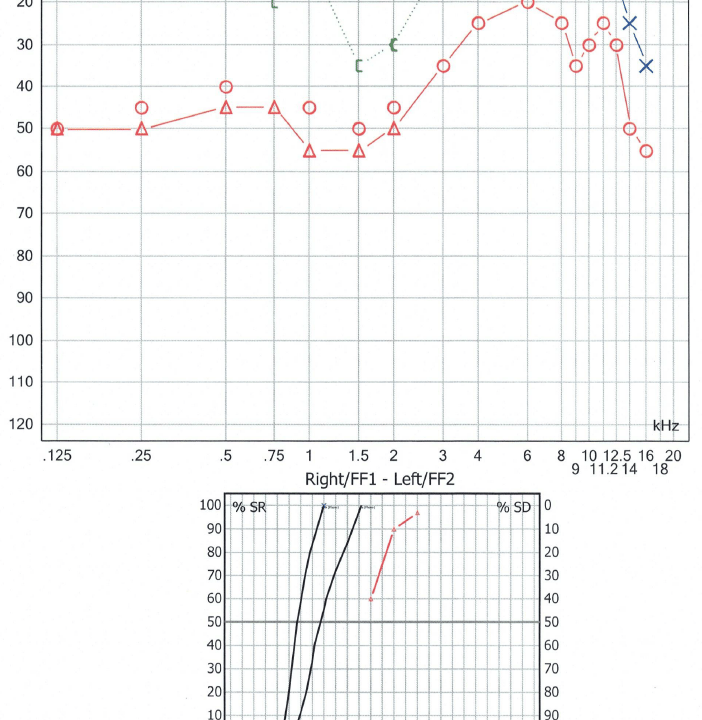
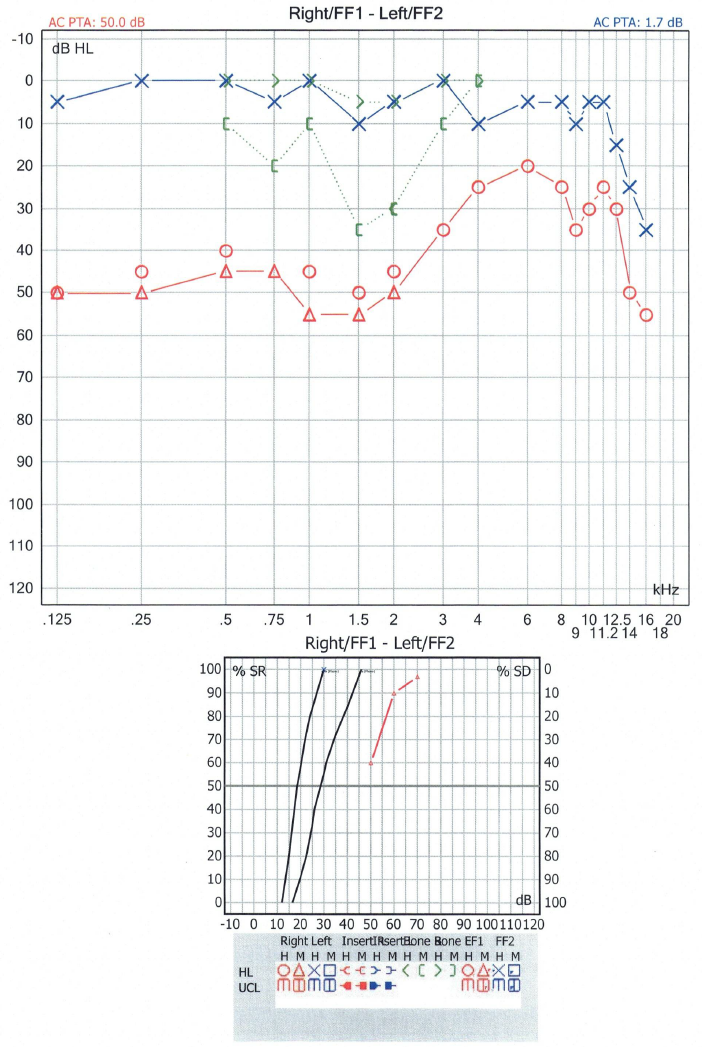
His pure tone audiometry showed a bilateral notch at 4000 Hz, with thresholds sitting around 40-45 dB HL at that frequency—moderate hearing loss in the exact range you’d expect from chronic noise exposure. His speech-in-noise testing was poor; he needed significantly more favourable signal-to-noise ratios than someone his age should. The tinnitus was permanent. The hearing loss was permanent.
We fitted him with custom musicians’ plugs, discussed practice strategies, and talked about the reality that he’d be managing this for the rest of his life. He was angry, not at me, but at himself. “Why didn’t anyone tell me this would happen?” Someone probably did. It’s just easy to ignore when you’re young and invincible and the damage is invisible.
What You Should Do Next
If you’re a drummer and you’ve never had a hearing test, book one. Not next month. This week. A baseline audiogram tells you where you’re starting from and gives us something to compare against in future. At The Audiology Place, a comprehensive assessment includes pure tone audiometry, speech testing, and tympanometry. We’ll talk about your specific exposure patterns and risk factors, and work out a protection strategy that fits your playing style and budget.
If you already know you have hearing loss or tinnitus, don’t wait for it to get worse. We can’t reverse the damage, but we can prevent further deterioration and help you manage symptoms. That might mean hearing aids, tinnitus management strategies, or simply ensuring you’re protecting what hearing you have left.
Annual hearing tests are a good idea for anyone with regular exposure to high noise levels. Catching changes early gives you a chance to adjust your protection strategy before the damage becomes severe.
The bottom line: drums are loud enough to wreck your hearing, and they probably will if you don’t protect yourself. Custom earplugs work. Electronic practice kits work. Monitoring your hearing with regular testing works. What doesn’t work is pretending it won’t happen to you.