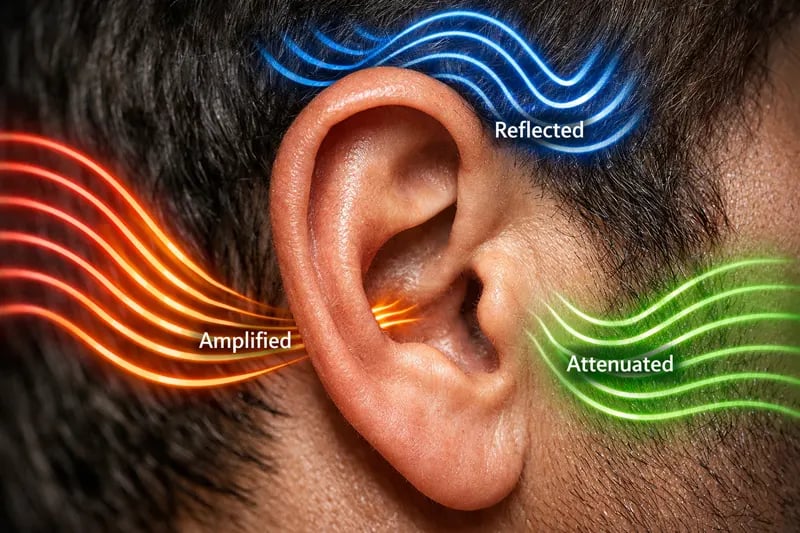
No two ears are the same. Even your left and right ears differ subtly in size, shape, and orientation. While most of us recognise that hearing relies on a complex partnership between our ears and our brain, there’s a fascinating piece of the puzzle that’s often overlooked: the physical shape of your ear actively filters and shapes sound before your brain ever processes it.
For decades, hearing healthcare has focused primarily on amplification and neural processing. Volume matters, of course, and so does the brain’s ability to interpret sound. But recent research is revealing what audiologists have long suspected: the unique geometry of your outer ear, the dimensions of your ear canal, and even microscopic variations in your middle and inner ear structures all play critical roles in how you hear—not just how loudly.
Understanding ear anatomy and hearing isn’t just an academic exercise. It has real-world implications for how we assess hearing loss, fit hearing aids, and support children’s auditory development. At The Audiology Place, we believe that truly personalised hearing care begins with recognising that your ears—like your fingerprints—are entirely your own.
The Outer Ear: Your Natural Sound Filter
The pinna, or auricle, is the visible part of your ear that sits on the side of your head. Far from a simple funnel, it has ridges, folds, and curves that perform sophisticated acoustic filtering, helping you make sense of the world around you.
When sound waves reach your ear, they don’t travel directly into the ear canal. Instead, they interact with the pinna’s complex three-dimensional structure. Specific frequencies are amplified, others are attenuated, and some are reflected in ways that create subtle timing differences. These modifications are highly frequency-specific and directionally dependent, meaning that a sound coming from in front of you will be filtered differently than one coming from behind or above.
This is why the shape of the ear matters profoundly for sound localisation. Your brain uses these acoustic cues—created entirely by the physical geometry of your pinna—to determine whether a sound is coming from the front or back, above or below. Without your outer ear’s distinctive shape, localising sound would be far more difficult, especially on the vertical plane. Humans evolved external ears precisely because they confer a survival advantage: the ability to locate threats, prey, or other members of our social group without needing to see them.
Interestingly, because each person’s pinna is shaped slightly differently, the way sound is filtered varies from one individual to the next. This has significant consequences for localisation accuracy. Research shows that people with more pronounced pinna features tend to localise high-frequency sounds more accurately. At the same time, subtle anatomical differences can lead to front-back confusion or difficulty judging elevation.
For audiologists, this highlights an important principle: hearing isn’t simply about detecting sound; it’s about interpreting a rich, three-dimensional auditory landscape, and that interpretation starts with the outer ear’s shape and the sound-filtering that occurs before sound ever enters the ear canal.
Ear Canal Shape and Resonance
Once sound passes the pinna, it travels down the ear canal—a structure that varies considerably in length, width, and curvature from person to person. The ear canal is not merely a passive conduit. Its dimensions create natural resonance, amplifying specific frequencies while leaving others relatively unaffected.
In adults, the ear canal typically provides a resonant boost in the range of 2,000 to 4,000 Hz, which aligns closely with the frequency range most important for understanding speech. This natural amplification is part of how the ear efficiently hears sound, enhancing clarity without requiring additional energy or neural effort.
Children’s ear canals, however, are shorter and narrower than those of adults. As a result, their resonant frequencies are higher, and their acoustic properties shift as they grow. This is one reason why paediatric audiology requires special attention: the same sound stimulus will be modified differently depending on a child’s age and stage of ear development.
From a clinical perspective, ear canal shape has profound implications for hearing aid performance. When a hearing aid is placed in the ear, it alters the canal’s acoustic properties. The length and curvature of the canal influence how sound waves interact with the hearing aid’s receiver, affecting the frequency response delivered to the eardrum. This is why “one-size-fits-all” amplification simply doesn’t work. Without accounting for individual ear canal geometry, amplification may be excessive at some frequencies and insufficient at others, leading to distortion, discomfort, or poor speech understanding.
This is where real-ear measurement (REM) becomes essential. REM allows audiologists to measure the actual sound pressure level at the eardrum, accounting for the unique resonance characteristics of each person’s ear canal. It’s a cornerstone of evidence-based hearing aid fitting and a key reason why The Audiology Place prioritises verification in every fitting.
The Middle and Inner Ear: Shape at a Microscopic Level
Beyond the outer and middle structures, even the tiniest anatomical variations in the middle and inner ear can influence hearing sensitivity and clarity.
The ossicle chain—comprising the malleus, incus, and stapes—acts as a mechanical lever system, amplifying sound vibrations as they travel from the eardrum to the inner ear. The geometry of these bones, including their size, density, and articulation angles, determines the efficiency of this transfer. Slight differences in ossicle morphology can affect how well soft sounds are detected or how clearly complex sounds are perceived.
Within the cochlea, the spiral-shaped organ of the inner ear, sound is further analysed into its frequency components. The cochlea’s tonotopic organisation means that different frequencies are represented at various locations along the basilar membrane. High-frequency sounds are processed at the base, while low-frequency sounds are processed at the apex. Variations in cochlear size, shape, and the mechanical properties of the basilar membrane contribute to individual differences in frequency sensitivity and dynamic range.
These structural nuances also help explain why some people experience asymmetrical hearing loss. Even when the underlying pathology is similar, anatomical differences between the left and right cochleae can result in different degrees or patterns of hearing impairment. This reinforces the importance of individualised assessment and tailored intervention strategies.
Cutting-Edge Research: Why Ear Shape Is Back in Focus
The role of ear anatomy in hearing is no longer a niche topic—it’s at the forefront of auditory science and hearing technology. Researchers and engineers are increasingly focused on understanding and leveraging the acoustic signature of individual ear shapes to improve sound quality, spatial hearing, and user experience.
Head-Related Transfer Function (HRTF) Research
One of the most exciting areas of study involves head-related transfer functions, or HRTFs. An HRTF describes how an individual’s unique ear shape, head size, and torso geometry alter incoming sound waves as a function of direction. By mapping these transformations, researchers can create personalised spatial audio experiences in virtual reality, gaming, and advanced hearing devices. HRTFs are also being integrated into hearing aids to restore more natural spatial cues, helping users better understand speech in noisy environments and navigate complex listening situations.
3D Ear Scanning and Printing
Advances in 3D scanning and printing technology are revolutionising the way custom ear moulds and hearing aid shells are made. Traditional impressions, while effective, can sometimes miss fine anatomical details or cause discomfort during the moulding process. Digital scanning captures the ear’s geometry with millimetre precision, enabling the creation of ear moulds that fit more comfortably, seal more reliably, and deliver better acoustic performance. This technology also allows for rapid prototyping and adjustments, reducing turnaround times and improving patient satisfaction.
AI-Driven Personalisation
Artificial intelligence is beginning to play a role in anatomy-aware signal processing. Algorithms can now analyse ear canal shape, eardrum characteristics, and even middle ear mechanics to predict optimal amplification strategies. This goes beyond traditional audiogram-based programming, tailoring hearing-aid output not just to hearing thresholds but to the acoustic properties of the individual’s ear. While still emerging, this research promises to make hearing aids more intelligent, more adaptive, and more effective.
Binaural Hearing and Spatial Hearing Studies
Understanding how asymmetrical ear shapes affect localisation and spatial hearing is critical for designing better binaural hearing solutions. Studies are exploring how differences between the left and right ears influence the brain’s ability to integrate sound from both sides, particularly in complex listening environments like restaurants or classrooms. This research is directly applicable to hearing aid users, many of whom struggle with spatial hearing despite wearing devices in both ears.
Why This Matters for Hearing Aids and Hearing Tests
The implications of ear shape for clinical audiology are clear: an audiogram alone doesn’t tell the whole story. While threshold testing is essential for identifying hearing loss, it doesn’t account for how your unique ear anatomy modifies sound before it reaches the cochlea.
This is why comprehensive hearing assessments at The Audiology Place include not just pure-tone audiometry, but also real-ear measurements, speech-in-noise testing, and careful evaluation of ear canal characteristics. Real-ear measurement is fundamental—it’s the only way to verify that hearing aids are delivering the right amount of amplification in the correct frequencies, given your specific ear canal resonance.
Custom ear moulds are another critical component of personalised hearing care. Off-the-shelf domes and tips can be convenient, but they don’t always provide the acoustic seal, comfort, or frequency response precision that a custom mould can deliver. For people with unusually shaped ear canals, sensitive skin, or high-level amplification needs, custom solutions are often essential.
Because The Audiology Place is independent and not tied to any single hearing aid manufacturer, we can select technology based on what works best for your anatomy, lifestyle, and listening goals—not on sales targets or brand loyalty. This brand-agnostic stance ensures that your care is evidence-based, transparent, and truly centred on your individual needs.
Children, Ear Shape, and Development
Children’s ears are not simply smaller versions of adult ears—they are acoustically different and continually changing. As the ear canal lengthens, the pinna grows, and the middle ear matures, the way sound is filtered and amplified evolves. This has important implications for paediatric audiology.
Early hearing assessments must account for these anatomical differences. Frequency-specific testing, appropriate probe tube placement during real-ear measurement, and age-appropriate ear mould materials all contribute to accurate diagnosis and effective intervention. Because children’s auditory systems are still developing, ensuring that they receive clear, well-localised sound is critical not only for hearing, but for speech and language development, social interaction, and educational success.
At The Audiology Place, we take a whole-of-family approach, recognising that a child’s hearing care is intertwined with their developmental stage, communication environment, and caregivers’ needs.
Why Personalised Audiology Matters
Understanding the role of ear anatomy in hearing helps explain why some people struggle with speech-in-noise despite having seemingly “mild” hearing loss, or why two people with similar audiograms can have vastly different experiences with the same hearing aid.
Individual differences in ear shape affect listening effort, fatigue, and long-term hearing outcomes. When amplification is not adequately matched to ear canal acoustics, users may experience poor sound quality, feedback, or discomfort—all of which can contribute to non-use or dissatisfaction. Conversely, when hearing care is truly personalised—taking into account outer ear shape, ear canal dimensions, and the user’s unique listening challenges—outcomes improve significantly.
At The Audiology Place, we’re committed to an individual-first, anatomy-aware approach. We recognise that your hearing journey is shaped not just by the sounds around you, but by the very structure of your ears. By combining thorough diagnostic testing, real-ear verification, custom solutions, and evidence-based fitting strategies, we aim to provide hearing care that respects your individuality and supports your long-term well-being.